


















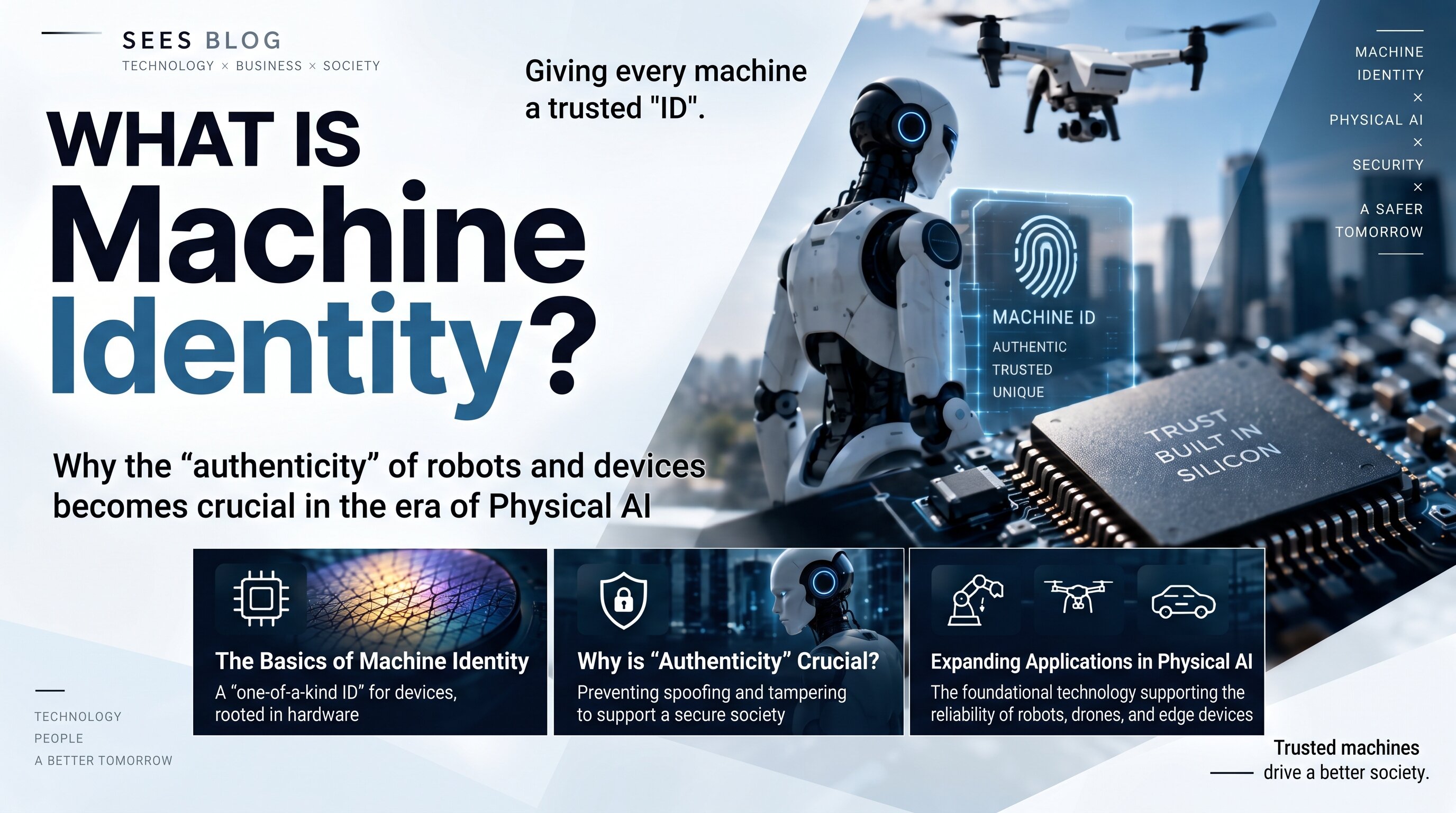
With the rapid proliferation of AI, robotics, drones, autonomous vehicles, and smart factories, network-connected "machines" are becoming increasingly sophisticated.
In Physical AI architectures, physical robots and devices gather telemetry via field sensors, AI models process the data to make decisions, and those decisions directly trigger physical actions in the real world.
Against this backdrop, a fundamental security question emerges: "Is this machine truly authentic?"
Machine Identity refers to cryptographic identities assigned to non-human entities--such as servers, IoT devices, robots, sensors, and edge nodes--to establish unique identification, authentication, and access control.
In Physical AI, Machine Identity moves beyond simply "possessing a device ID string" to encompass hardware authenticity--determining the extent to which a system can verify that a device is genuine physical hardware.
- What Machine Identity is
- Key differences between Human Identity and Machine Identity
- Why Machine Identity is essential for Physical AI
- The distinction between a static device ID and hardware authenticity
- Critical considerations when using digital certificates and secret keys
- The relationship between PUFs and Machine Identity
- Establishing Hardware Authenticity via Chip Fingerprints
- Connecting Machine Identity with Data Trust
- Linking Machine Identity to Physical AI Trust Infrastructure
- What Is Machine Identity?
- Human Identity vs. Machine Identity
- Why Machine Identity Is Critical in Physical AI
- Is Having a Device ID Enough?
- Common Technical Approaches to Machine Identity
- The Relationship Between PUFs and Machine Identity
- Hardware Authenticity via Chip Fingerprints
- Connecting Machine Identity with Data Trust
- Why the Trust Chain Starts with Machine Identity in Physical AI
- Key Domains Requiring Machine Identity
- From Machine Identity to Physical AI Trust Infrastructure
- Summary
- Frequently Asked Questions
What Is Machine Identity?
Machine Identity refers to unique digital credentials assigned to non-human hardware entities--such as servers, IoT devices, robots, sensors, and edge compute nodes--for identification and access governance.
When humans access web services or corporate networks, systems verify "who is accessing the network" using credentials like user IDs, passwords, and multi-factor/biometric authentication.
Similarly, when machines communicate autonomously in machine-to-machine (M2M) environments, systems require automated mechanisms to answer: "Which machine is communicating?" and "Can this machine be trusted?"
Think of it as the framework that establishes "what this communicating device is" and enforces cryptographic authentication and access control.
In Physical AI architectures, security must go beyond software-level credentials to verify the physical authenticity of the underlying hardware substrate itself.
Human Identity vs. Machine Identity
Traditional IT security focused heavily on Human Identity Management--managing credentials, privileges, and access rights for human users.
| Parameter | Human Identity | Machine Identity |
|---|---|---|
| Target Entities | Humans | Machines, physical devices, software agents |
| Examples | Employees, customers, system administrators | Robots, sensors, IoT nodes, servers, microservices |
| Auth Credentials | Usernames, passwords, MFA, biometrics | Digital certificates, API keys, silicon signatures, tokens |
| Primary Objective | Identify and authenticate human users | Identify and authenticate machine nodes |
| Physical AI Focus | User and administrative access control | Hardware authenticity, device trust, and Machine Zero Trust |
Why Machine Identity Is Critical in Physical AI
In Physical AI systems, robots and edge nodes generate data autonomously, transmitting telemetry feeds directly to AI models and peer devices.
Consider an autonomous commercial drone:
When an AI model receives telemetry, verifying the payload content is only part of the task--the system must also verify which specific hardware device generated the data.
- Is the transmitting device authentic?
- Is the hardware an unauthorized rogue or cloned device?
- Is communication strictly tied to expected hardware endpoints?
- Can the data payload be conclusively linked to an authentic device?
- Can data authenticity and payload integrity be verified end-to-end?
Because AI decisions directly trigger physical movement, Machine Identity forms the foundational pillar of Device Trust.
Is Having a Device ID Enough?
Identifying a device can be accomplished using static strings like serial numbers, IP addresses, or MAC addresses.
However, in Physical AI security, "possessing an identifier string" is fundamentally different from "verifying that the underlying physical hardware is authentic."
Assigns a label or string to answer "which device is this?"
Applies cryptographic protocols to verify the device's claimed identity.
Determines whether the physical device itself can be validated as genuine hardware.
Common Technical Approaches to Machine Identity
Various technical implementations are deployed to achieve Machine Identity depending on application constraints and security requirements.
Utilizes Public Key Infrastructure (PKI) to authenticate communicating endpoints.
Employs symmetric or asymmetric keys stored on device memory for session authentication.
Utilizes tamper-resistant hardware coprocessors to safeguard private keys.
Exploits inherent silicon micro-variations to generate hardware-bound identity anchors.
These approaches are complementary rather than mutually exclusive, and are frequently combined to build multi-layered Machine Identity frameworks.
The Relationship Between PUFs and Machine Identity
A PUF (Physical Unclonable Function) is a hardware security technology that leverages microscopic physical variations in semiconductor manufacturing.
Even semiconductors manufactured using identical fabrication masks exhibit subtle silicon-level variations.
By extracting these silicon variations as a device-unique signature, PUFs establish a hardware root of trust for Machine Identity and device authentication.
While a PUF component alone does not cover every aspect of Machine Identity, it serves as a critical hardware root of trust for building unclonable device authentication.
Hardware Authenticity via Chip Fingerprints
At SEES Inc., we are developing proprietary Chip Fingerprint technology that extracts unique physical silicon variations from semiconductors.
Our approach leverages Chip Fingerprints to confirm hardware authenticity, establishing the root anchor for Device Trust across Physical AI ecosystems.
Connecting Machine Identity with Data Trust
While establishing Device Trust via Machine Identity is essential, it does not guarantee end-to-end security on its own.
Systems must also answer: "Can the telemetry payloads sent from this device to the AI be verified as authentic and unaltered?"
SEES Chip Fingerprints establish hardware device authenticity at the silicon layer.
SEES Hash Chains utilize cryptographic Seeds to verify data source authenticity.
Hash Chains verify that telemetry payloads remain completely unaltered post-generation.
Hash Chains confirm that the sequential time-series ordering of streaming data remains intact.
Why the Trust Chain Starts with Machine Identity in Physical AI
In Physical AI systems, physical devices, streaming data, communication networks, AI engines, and mechanical controllers operate as an interconnected pipeline.
Within this Trust Chain, Machine Identity acts as the starting root for Device Trust--determining which physical devices are trusted.
Key Domains Requiring Machine Identity
Machine Identity becomes vital in autonomous operational environments where devices communicate and execute tasks without human oversight.
Authenticating robotic controllers, embedded sensor arrays, and onboard processing units.
Establishing Machine Identity across drone airframes and establishing inter-device trust for swarms.
Establishing peer-to-peer hardware trust across connected vehicles, ECUs, and ADAS modules.
Authenticating industrial robots, field sensors, PLCs, gateways, and edge compute nodes.
Confirming hardware provenance and physical authenticity at the component and chip level.
Identifying scale-out edge deployments and managing authorized M2M communications.
From Machine Identity to Physical AI Trust Infrastructure
As Physical AI matures, managing human credentials alone is insufficient--machines require unclonable, cryptographic identities.
However, Machine Identity is not a standalone solution on its own.
- Hardware root authenticity
- Device identification and authentication
- Data/software source authenticity
- Data payload integrity
- Sequential stream continuity
- In-transit tamper protection and verification
- Verification of incoming AI data feeds
- Trust verification extending to mechanical actuators
SEES Inc. is building a robust Physical AI Trust Infrastructure by integrating Chip Fingerprints, Hash Chains, and Scramble Memory.
Summary | Machine Identity Is Vital in the Physical AI Era
Machine Identity provides unique, verifiable digital identities for non-human entities--such as robots, field sensors, IoT nodes, and servers--to enable secure authentication and access governance.
In Physical AI, because AI inferences drive physical machinery in the real world, establishing Device Trust--answering "which device transmitted this data?" and "is this physical hardware genuine?"--becomes essential.
- Uniquely identifying hardware nodes and devices
- Cryptographically authenticating devices
- Verifying physical hardware authenticity
- Building a trusted link between devices and data streams
- Underpinning the trustworthiness of input data feeding AI models
SEES Inc. utilizes Chip Fingerprints to verify Hardware Authenticity and software Hash Chains to validate Data/Software Authenticity, Integrity, and Continuity.
Before asking "Can we trust the AI?", we must confirm: "Can we trust the physical machines sending data to the AI?"
Machine Identity serves as the essential starting point for building Physical AI Trust Infrastructure.
Frequently Asked Questions About Machine Identity
What is Machine Identity?
Machine Identity refers to digital credentials assigned to non-human entities--such as servers, IoT devices, robots, and sensors--to enable unique identification, authentication, and access control in M2M environments.
Is Machine Identity the same as a Device ID?
Not necessarily. A Device ID is a static string used for identification. Machine Identity encompasses identity verification, cryptographic authentication, access governance, and hardware authenticity.
Why is Machine Identity critical in Physical AI?
Because AI models process streaming telemetry generated by field devices to execute physical real-world actions. Verifying which physical hardware generated the input data is a fundamental prerequisite for Device Trust.
What is the relationship between PUFs and Machine Identity?
A PUF (Physical Unclonable Function) exploits microscopic silicon manufacturing variations to establish a hardware root of trust, providing an unclonable physical foundation for Machine Identity.
What is a Chip Fingerprint?
It is a technology developed by SEES Inc. that extracts unique physical silicon characteristics from semiconductors to identify hardware nodes and verify hardware authenticity.
Can Machine Identity alone secure a Physical AI ecosystem?
No. Machine Identity is a foundational layer. Comprehensive security requires combining Device Trust with data authenticity, payload integrity, stream continuity, transmission security, and AI model protection.
How do Hash Chains integrate with Machine Identity?
SEES Inc. uses Chip Fingerprints to establish hardware device authenticity at the physical layer, while Hash Chains use Seeds to verify data/software source authenticity alongside payload integrity and stream continuity. Together, they bridge Device Trust and Data Trust.