
Autonomous Decentralized AI Cell & Hashchain Are the Core Technology of the Physical AI Era.
Sees Co., Ltd.
Sees Co., Ltd.
-
Back
Physical AI
Ahead of the rise of physical AI, we developed our proprietary "Autonomous distributed AI" technology.-
 Autonomous Distributed AI Cell
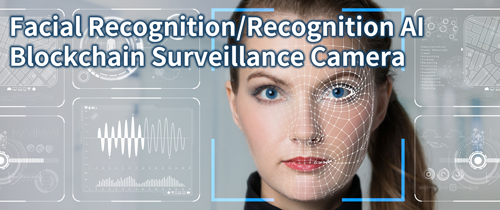
Proprietary technology chip realizing the ultimate Physical AI by operationalizing the Child AI concept and integrating it with Hashchain.Facial Recognition/Recognition AI Blockchain Surveillance Camera
Ultimate AI Blockchain surveillance camera integrating facial recognition AI into a Blockchain chip.AI Poisoning Prevention System
System completely preventing Data Poisoning vulnerabilities in AI equipped with an AI Front-End Engine.Data Security
We provide end-to-end data security from sensors to the cloud.-
Scramble Memory
Ultimate data recording method realizing the Zero Trust concept that remains unreadable even if stolen. -
Hashchain
Hashchain is the ultimate innovative technology in data security providing seamless end to end data protection from sensors to the cloud. -
Sees Blockchain
Blockchain optimized for industrial use realizing simultaneous operation of multiple applications through parallel processing. -
Sees Blockchain Security System
Security system linking blockchain products that satisfy four information security requirements of leakage prevention tampering prevention stable operation and user authentication. -
Blockchain Chip
Revolutionary technology in IoT control data security shrinking embedded blockchain into a single chip. -
Mobile Blockchain Nodes
Converts mobile devices into blockchain nodes and protects transmitted and received data through a blockchain network. -
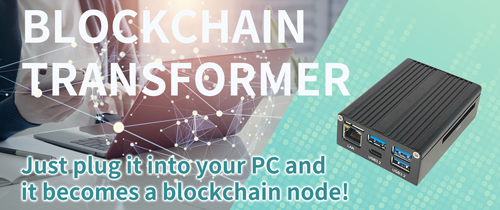
Blockchain Transformers
Blockchain dongle that builds a blockchain node simply by connecting to a USB port. -
Blockchain Gateway
Builds a blockchain environment via LAN connection and protects transmitted and received data with robust security. -
Blockchain Server
Server preinstalled with industrial blockchain enabling immediate blockchain node setup upon installation.
DApps (Decentralized Applications)
DApps (decentralized applications) that utilize our proprietary "Continable NFT" technology.-
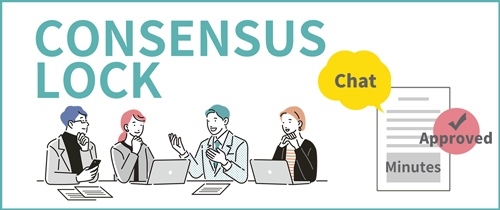
Consensus Lock
Shares consensus and conclusion among all meeting participants to prevent unnecessary trouble in advance. -
Beneficial Avatar
Clone trained on your own thinking and knowledge working on your behalf twenty four hours a day. -
NFT-based reservation rights issuance and trading system
Reservation right NFT issuance system realizing automated fair trade in bookings.
Development and Implementation Support
Whether it’s IT development or digital transformation (DX) implementation, feel free to consult us about anything related to IT.-
Pre-packaged Blockchain
Builds and operates blockchain applications answering any needs for customization costs alone. -
Sees Blockchain Development SDK
Software development kit with technical support that enables building blockchain applications without prior blockchain technology expertise. -
Blockchain custom-made development
Builds original blockchain within a low budget and short period while integrating with existing applications. -
Support for blockchain implementation
Total support service for blockchain digital transformation. -
Blockchain Learning Tool "Hakoniwa System"
World only blockchain learning tool for learning smart contracts while operating blockchain in a closed environment. -
 Sees Blockchain Linux
Linux optimized for blockchain to operate blockchain at high speed and with stability.
-

-
Back
Essence
We explain our intellectual property and technologies in an easy-to-understand way.-
Overview of Core Businesses
Overview of Sees Core Businesses. -
Sees Solutions
Solutions available through Sees products. -
The Future and Hope of Blockchain
Blockchain’s potential and the challenges to its adoption in Japan -
Autonomous Decentralized AI Cell Story
The core technology that logicized the concept of "Child AI" that autonomously learns, which is essential in the era of physical AI. -
Scramble Memory Story
The ultimate data security recording technology that achieves Zero Trust, born from the concept of protecting the data itself rather than the storage medium. -
Sees Hashchain Story
The origin story of Hashchain which represents the culmination of highly reliable technology in data transmission. -
Sees Blockchain Story
The journey of "Sees Blockchain," which continues to evolve by overcoming the barriers to industrial use through creativity and technical capability. -
Sees Blockchain Introduction
The story of blockchain from its dawn to the birth of Sees Blockchain. -
Sees Future Prospects
We will create the next generation of IT culture in the Physical AI and data security fields by bringing together technological capabilities cultivated in cutting edge infrastructure domains.
-

Prologue
Bitcoin, which began operating in 2009, had a tremendous impact on the world as a mechanism that allowed parties to complete transactions securely between themselves without going through financial institutions, and its core technology is blockchain.
From around 2016, many books were published and blockchain became known to people around the world as a promising fintech technology, but crypto assets and fintech are only a small part of blockchain's potential.
Blockchain is not merely a secure transaction ledger technology; what deserves the highest praise is its excellent distributed technology. It is precisely because it is a perfectly distributed technology that consensus is formed among nodes and parties can transact securely with one another without a third party, and even now many people have not noticed this.
Linux, an open-source OS, once spread quietly, deeply and steadily into industry over many years. Today few people are ever aware of Linux, yet from automatic ticket gates and train control at stations to many cars and home appliances, people's lives are supported by Linux. We are convinced that blockchain will follow the same path and become a familiar presence that everyone uses without being aware of it.
Looking around the world, moves to use blockchain as a foundation for social infrastructure are already accelerating, but in Japan many people still view it with skepticism and it has not reached the stage of full-scale adoption. We will explain later why so many people in Japan are skeptical; for now, what stands out is simply the fact that Japan has fallen far behind the global trend in core technology.
The Dawn of Industrial Blockchain: The Challenge of Sees
The dawn of blockchain was a paper published by Satoshi Nakamoto in 2008, which presented a mechanism allowing parties to transact directly with each other over the Internet without going through financial institutions.
In January 2009, Bitcoin, the world's first crypto asset using the technology described in this paper, was born, and it attracted worldwide attention as a transaction system that keeps running unattended even though no one manages it.
In 2015, Ethereum appeared, allowing not only transaction ledgers but also applications to run on the blockchain. As a result, smart contracts, which automatically execute contracts when conditions are met, were put into practical use, and blockchain transformed from a transaction ledger technology into a distributed technology that can be used in every industry.
Sees Co., Ltd. began researching blockchain in 2014, ahead of other companies and before any books on the subject had been published in Japanese. Even at that time, Sees was already convinced that blockchain was not a limited transaction ledger technology but a distributed processing technology ideal for data security that could be used in every industry, and a core technology that should be used throughout the world in the near future.
Sees found two values in blockchain: one is that it is a highly secure technology that cannot be tampered with, and the other is that it is an advanced distributed processing technology.
Books on the market evaluate blockchain only as a cryptographic technology that cannot be tampered with, and of course being tamper-proof is extremely important.
However, we believe that what truly delivers results in industrial settings is the fact that it is a perfect distributed processing technology.
The greatest feature of distributed processing is that even if one server on the network stops due to an accident or failure, the other nodes immediately cover for it, and the system as a whole keeps running without stopping as if nothing had happened.
In addition, because the data itself is held in an identical state at multiple locations, even if data is completely erased from a server, the data of the system as a whole is never lost.
And this complete distributed processing can be achieved easily simply by introducing blockchain, without modifying complex existing system configurations.
This brings an immense benefit to industry, which pursues uptime and stability every day.
Furthermore, if this distributed processing mechanism can be reproduced not only in large dedicated server groups but also in small terminals placed on site and in chips built into equipment, it will be possible to achieve processing speed, stability and resilience to failures all at once, on a scale incomparable to conventional systems.
What Sees envisioned is a world in which data is transmitted and recorded securely from the moment it is created, across the network and all the way to the finest details at the edge; this is the very value Sees found in blockchain.
Sees has created each of its products around these two values: tamper-proofness and distributed processing.
"Sees Blockchain," born in 2018, is the result of pursuing the value of distributed processing.
It is a data security system for industry that highly integrates a dedicated Linux with middleware developed in-house around a configuration similar to Ethereum and the concept of a distributed file system.
The "Multi-DApps Platform," which allows multiple applications to securely share a single blockchain, "Sees Blockchain Linux," specialized in the minimum necessary functions, and the "Blockchain Gateway," "Blockchain Transformer" and "Blockchain Chip," which embed blockchain into devices, are all products for extending distributed processing to every corner of the field.
Sees has further applied this concept of distributed processing to AI and developed it into the "Autonomous Decentralized AI Cell," in which small cell computers learn from one another. The "Autonomous Decentralized AI Cell" can be called Sees' challenge to the next-generation field of physical AI, and Sees intends to compete in the physical AI field with distributed technology.
On the other hand, the result of pursuing the value of tamper-proofness is the patented technology "Hashchain," which could be called Layer 3 of blockchain. "Scramble Memory" applies this technology, which guarantees data along the transmission path even before it is recorded in the blockchain, to storage devices to achieve zero trust.
In this way, the technologies born from these two pillars have merged into a single advanced data security technology that protects data end to end, from sensors to the cloud.
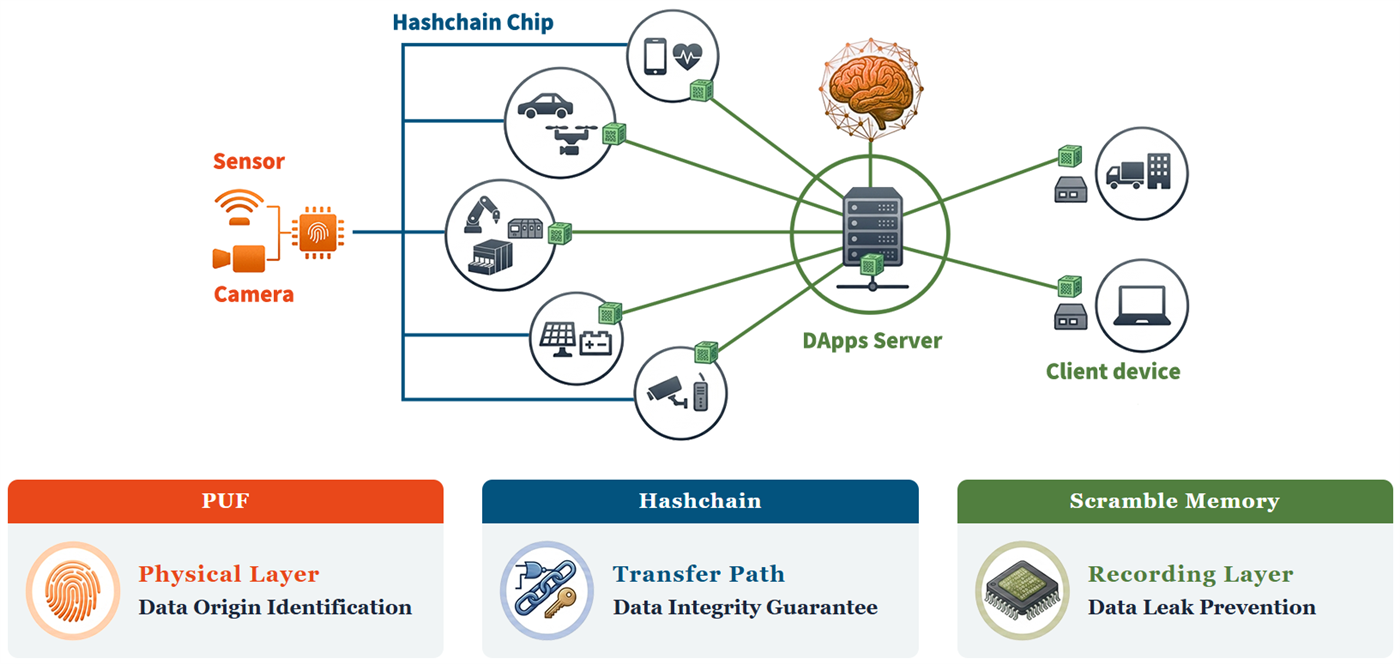
Today, when the security of both transmitted and stored data is indispensable, Sees has established a mechanism that protects every stage end to end, from the moment data is created by a sensor until it reaches the cloud and is recorded.
At its core are three proprietary patented technologies.
The first is the one-of-a-kind "PUF," which guarantees the origin of data at the chip level.
The second is "Hashchain," which guarantees the legitimacy of transmitted data segment by segment.
The third is "Scramble Memory," which ensures that no one but the owner can see stored data, even if it is stolen.
With these three proprietary technologies, Sees' data security system guarantees the authenticity, confidentiality and integrity of information, and combines them with the resilience to keep running without stopping even when attacked.
Here, the two values of tamper-proofness and distributed processing have come together as one.
In 2026, Sees reorganized its business to promote all of these comprehensively.
Its two pillars are the "Physical AI" business, with the "Autonomous Decentralized AI Cell" at its core, and the "Data Security" business, with "Hashchain" and "Scramble Memory" at its core.
The name Sees comes from the plural of "see": "to see the future, to see the trends of the world, and to see an accurate vision of what may happen in the future." Sees' technology, which began with blockchain, has merged with AI and continues to evolve into the foundation of the next era.
Benefits of Introducing Blockchain
Systems that use blockchain have many excellent advantages that conventional systems do not, and we will explain them one by one.
The first is that you can obtain a system that does not stop.
In conventional systems that depend on a specific server or cloud provider, a failure in one place brings the entire system to a halt.
Because blockchain distributes data and processing across multiple nodes, the system as a whole does not stop even if part of it fails, and its strong fault tolerance, which allows it to survive without losing data or functions, is also of great value from a management perspective.
Moreover, this distributed processing can be achieved simply by introducing blockchain, without significantly rebuilding existing systems.
The second is that the cost of ensuring trust can be greatly reduced.
In conventional systems, backups and logs had to be managed to prove that records had not been rewritten afterward. Blockchain, by contrast, has a structure that makes tampering practically impossible built in from the start, so the cost of explanations and audits to prove that your company is trustworthy can be greatly reduced.
The third is that on-site procedures can be automated, eliminating delays and errors caused by human handling.
A smart contract is a mechanism in which a program reliably executes a predetermined process as soon as predetermined conditions are met.
For example, when a sensor on manufacturing equipment records a value indicating wear on a part, everything up to ordering replacement parts and scheduling maintenance is done automatically, and when passing an inspection process is recorded, the procedures move on automatically to the next process or shipment.
If the temperature goes out of range during frozen or refrigerated transport, the fact is recorded and the companies concerned are notified immediately. The work of having people check, circulate documents and approve them disappears, and oversights and procedural delays are eliminated by the system itself.
The fourth is that data can be shared securely among multiple companies.
In operations involving multiple companies, such as supply chains, the question of whose server should hold the data always arises. As a neutral platform that belongs to no single company, blockchain allows participating companies to share the same data and use it in a state that no one can rewrite at will.
The fifth is that it can prove that data has not been tampered with, increasing a company's credibility and brand value.
In a conventional database, anyone with administrative privileges can rewrite records afterward, whereas anyone can objectively verify that information recorded on a blockchain has not been tampered with.
In the case of food, for example, consumers themselves will be able to check the records from the producer to the factory and all the way to the store shelf. This leaves no room for false labeling of origin or falsification of quality data, so the companies that honestly make only good products will be the ones that are properly valued.
These advantages are already being put to use by many companies and institutions.
Many world-renowned companies and institutions now use blockchain for purposes such as proving the existence of design drawings and experimental data, tracking food distribution routes, and proving the authenticity of university degree certificates and electronic contracts.
Why Is Blockchain So Strong in Security?
What speaks most eloquently of blockchain's security strength is the very fact that it has never once stopped and has never once been hacked.
Bitcoin's blockchain, which began operating in January 2009, has kept running for nearly 20 years on the Internet, where anyone in the world can participate and anyone can attempt an attack, without stopping even once and without succumbing to attacks, and Ethereum, which began in 2015, likewise continues to run while processing an enormous number of transactions around the world.
Even though the world's skilled hackers keep targeting its enormous wealth, the blockchain itself has never once been taken over or stopped.
The crypto asset theft incidents that make the news were not cases of the blockchain being broken; they targeted peripheral areas separate from the blockchain network, such as theft of private keys, wallet bugs, and intrusions into exchange servers or users' devices.
So why does blockchain never stop and never get broken?
The reason lies in three mechanisms: distributed processing, a data structure that links records like a chain, and consensus building among participants.
Let us start with distributed processing.
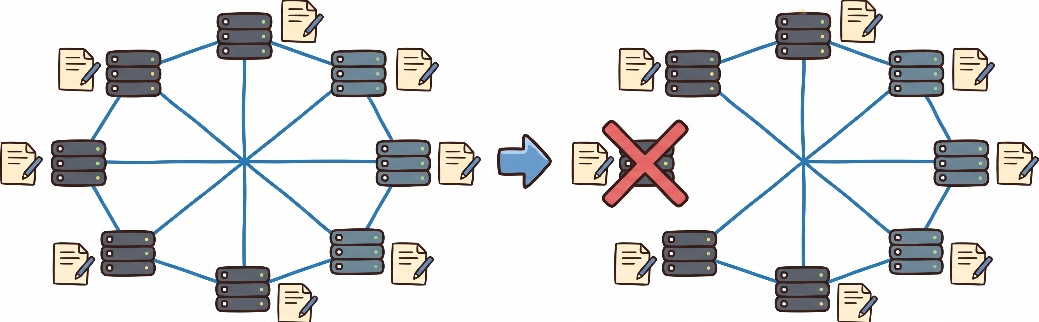
Conventional systems manage data on a single server, so an attack can bring the entire system down, whereas in a blockchain, multiple nodes each hold the same ledger and perform the same processing.
Even if one node is attacked and stops, the other nodes continue processing, so the system as a whole never stops. Even if a node is hijacked and produces fraudulent data, the other nodes that receive the data rigorously verify it and discard it as soon as it is found to be fraudulent, and this is the main reason blockchain has never stopped and never been broken.
Next is the data structure that links records like a chain.
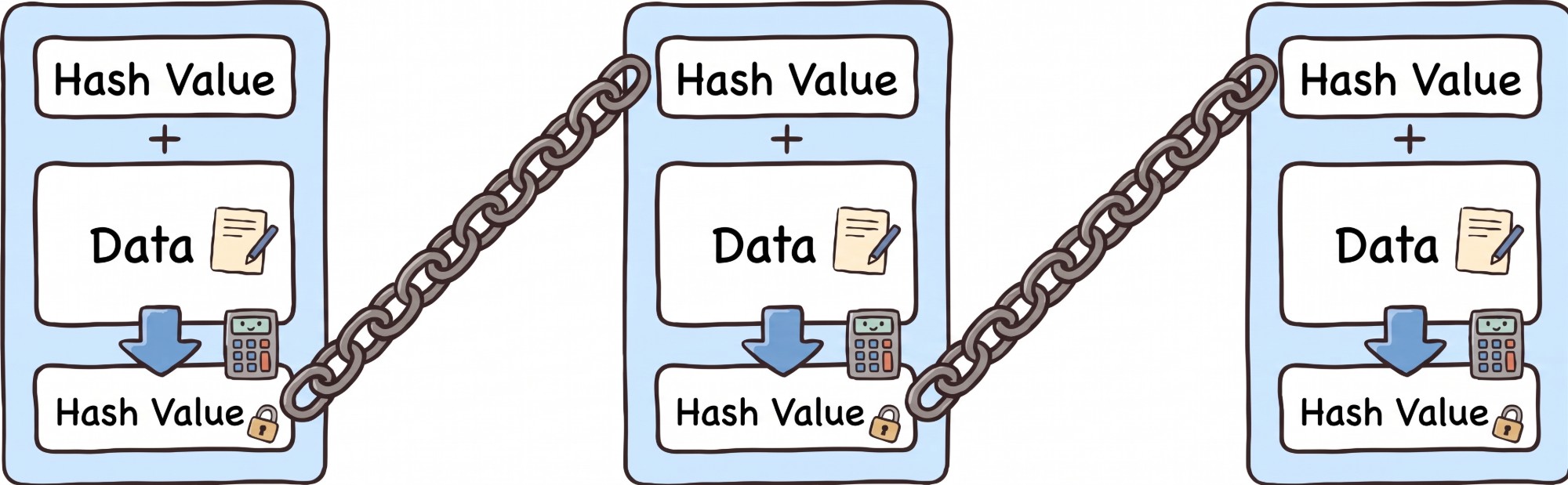
What is used here is a cryptographic technique called a cryptographic hash function. It converts data of any size into a value of fixed length by passing it through a fixed formula, and that value is called a hash value.
The same data always produces the same hash value, but if the original data differs by even one character, the hash value becomes completely different. Furthermore, it is practically impossible either to derive the original data from a hash value or to create different data that produces the same hash value.
In a blockchain, records are grouped into units called blocks at regular intervals.
Each new block contains the hash value of the previous block.
Like a tally seal across documents, the blocks certify each other's contents and are linked in a single line like a chain; the name blockchain comes from this chain of blocks.
If even one block along the way is rewritten, its hash value changes and no longer matches the value written in the next block.
To make everything consistent, all subsequent blocks would have to be recreated, and since the chain is also compared with the same chain held by other nodes, tampering is detected immediately.
And finally, consensus building among participants.
Adding a new record to the ledger requires agreement among the participants, and this is called a consensus algorithm.
To succeed in fraud on a public blockchain, one would have to hijack a majority of the participants at the same time, and on top of that, cryptographic technologies such as hashing and digital signatures stand in the way as a mathematical barrier.
"Sees Blockchain" optimizes this mechanism for industrial use, because a public blockchain that discloses all data to an unspecified number of people cannot protect corporate confidential information.
Sees therefore adopted as its basic model a private blockchain that uses a consensus algorithm called PoA (Proof of Authority), in which only strictly approved validator nodes generate blocks.
By building the network only with trusted nodes, it prevents unauthorized intrusion from outside and eliminates the enormous computation of mining, achieving extremely fast distributed processing.
Sees also turned its attention to the stage before data is recorded in the blockchain.
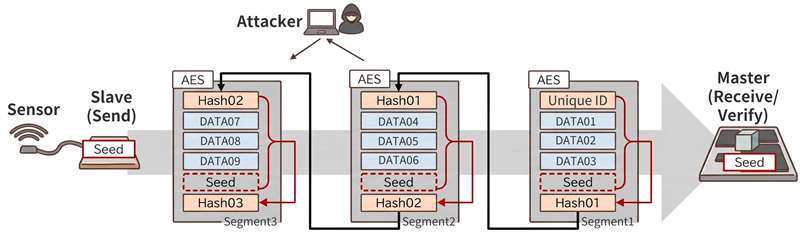
No matter how robust the inside of a blockchain is, if data is rewritten along the transmission path from a sensor to the blockchain, the record cannot be called correct.
Sees' patented technology "Hashchain" applies this blockchain technology to data transmission.
By dividing transmitted data into segments of a fixed size and linking them like a chain, combining the hash value of the previous segment with unique information known only to the terminal, it detects tampering, loss and spoofing during communication in real time.
Guaranteeing data end to end, from the moment it is created until it is recorded, is precisely what Sees means by security.
Why Is Blockchain Not Spreading in Japan?
As we have seen, blockchain combines excellent distributed processing that has never stopped with high, tamper-proof security.
Nevertheless, full-scale adoption of blockchain has been slow to progress in Japan, and before answering that question, let us first look at what is happening around the world.
In Europe, the EU fully applied MiCA, a comprehensive regulation of crypto assets, in December 2024, clarifying the rules and creating an environment in which businesses can enter the market with confidence.
At the same time, the EU itself operates EBSI, a blockchain infrastructure, and is advancing a mechanism that allows degrees and administrative certificates to be verified as genuine in any country.
In addition, the Digital Product Passport, which records history from manufacturing to reuse, will become mandatory from 2027, and blockchain has been adopted as one of the technologies for keeping product histories in a tamper-proof form.
In the United States, spot Bitcoin ETFs were approved in January 2024 and a stablecoin bill was enacted in July 2025, and in parallel, major financial institutions are working to handle real-world assets such as government bonds and funds on blockchain.
Major retailers adopted blockchain early on for systems that trace the origin of food.
China completely banned crypto asset trading and mining in 2021.
On the other hand, in 2019 it positioned blockchain as a key national technology, and since 2020 it has been developing BSN, a state-led infrastructure network.
It clearly separates crypto assets from blockchain technology and is actively promoting the latter as a foundational technology for society.
Hong Kong launched a licensing regime for crypto asset exchanges in 2023 and enacted a stablecoin ordinance in 2025.
Dubai set out a strategy in 2016 to move government documents onto blockchain, and in 2022 established a dedicated regulator for crypto assets and has been attracting related companies.
What these countries and regions have in common is that they are advancing, at the same time but as separate issues, the development of rules for crypto assets and the use of blockchain as an infrastructure foundation for society and industry.
Table 1. Major Developments in Japan and the World
| Country / Region | Crypto Asset and Financial Rules | Use in Industry and Government |
|---|---|---|
| EU | Dec. 2024: Full application of MiCA, a comprehensive regulation of crypto assets | Operates its own blockchain infrastructure, EBSI, to verify degrees and administrative certificates Digital Product Passport for batteries mandatory from 2027 |
| United States | Jan. 2024: Spot Bitcoin ETFs approved Jul. 2025: Stablecoin law enacted | Major financial institutions expanding efforts to handle government bonds and funds on blockchain Major retailers using it to trace the origin of food |
| China | 2021: Complete ban on crypto asset trading and mining | 2019: Blockchain positioned as a key national technology From 2020: Development of BSN, a state-led infrastructure network |
| Hong Kong / Dubai | Hong Kong: 2023 licensing regime for exchanges; 2025 stablecoin ordinance Dubai: 2022 dedicated regulator established | Dubai: 2016 strategy to move government documents onto blockchain Attracting related companies |
| Japan | 2017: Registration system for crypto asset exchanges, ahead of the rest of the world 2023: Stablecoin framework put into effect 2025: Issuance of yen-denominated stablecoins begins | Mainly proof-of-concept trials; full-scale use as an industrial foundation remains limited |
Incidentally, Japan was the first country in the world to establish a registration system for crypto asset exchanges, in 2017.
It also put its stablecoin framework into effect in 2023, establishing rules earlier than the United States.
In other words, Japan is by no means behind the world in creating rules for crypto assets.
Where Japan lags far behind is in efforts to use blockchain as a foundation for industry and government; in Japan, discussion of blockchain has stayed almost entirely on crypto asset rules, and for some reason the idea of using it as a foundation for society and industry has not spread.
Admittedly, there have been virtual currency fraud cases: in Japan, a major crypto asset exchange collapsed in 2014, and in 2018 a huge amount of crypto assets was stolen.
In addition, there was no end to ICO frauds selling worthless crypto assets at high prices and investment frauds collecting money by promising high returns.
We believe that the wide media coverage of these incidents and frauds has fixed an impression of blockchain as something speculative and dangerous.
However, as mentioned earlier, these incidents were not cases of the blockchain itself being broken, but problems that occurred around crypto assets, which are just one aspect of it.
We believe that only the bad impression spread, without the difference being properly conveyed.
In addition, there is probably anxiety about unintentionally violating laws and regulations with heavy penalties.
Because blockchain is easily linked to tokens and the transfer of value, depending on how it is built it may conflict with the Payment Services Act and the Financial Instruments and Exchange Act, as well as the gambling provisions of the Penal Code, the Act against Unjustifiable Premiums and Misleading Representations, and the Act on the Protection of Personal Information.
Regulation of crypto assets is becoming stricter year by year, and the system is currently being reviewed with a view to bringing crypto assets under the even stricter Financial Instruments and Exchange Act.
Because the impression that blockchain equals crypto assets is so strong, we believe that quite a few companies hesitate to introduce it, fearing that even industrial blockchain unrelated to crypto assets might break the law.
However, Sees believes that the biggest reason blockchain has not spread in Japan lies elsewhere.
It is that hardly anyone knows that the true value of blockchain lies in distributed processing, and that there are extremely few people who can properly evaluate that value compared with other countries; this is a fact based on Sees' experience of engaging with several hundred major companies over 10 years.
In Japan, the word blockchain has almost without exception been discussed in connection with crypto assets, and as a result many companies have regarded blockchain as something from the world of finance and fintech, a technology unrelated to their factories, logistics and daily operations.
Let us say this clearly: the essence of blockchain is not crypto assets.
Blockchain is a high-performance system that allows anyone to easily achieve distributed processing.
Building a distributed processing system from scratch normally requires advanced expertise, enormous development costs and a great deal of time.
But by introducing blockchain, you can obtain an entire distributed processing mechanism in which the system as a whole does not stop and data is never lost even if one node stops.
It is precisely in industrial settings that handle data that must never be lost, such as production equipment operating data, product quality inspection records and orders with business partners, that blockchain shows its greatest strength.
Another reason it has not spread in Japan is the difficulty of understanding its structure and the shortage of engineers.
It is not easy to explain clearly within a company why it does not stop and why it cannot be tampered with, and to obtain approval.
This is precisely because neither those explaining nor those listening can easily picture a structure that has never existed before. Many Japanese people view things they cannot understand with skepticism, while people in other countries see things they cannot understand as new, advanced and attractive, and we feel there is a major difference between countries here.
Furthermore, only a handful of companies have in-house engineers who can write smart contracts or a system for auditing security, and as a result there were in fact quite a few cases that ended with proof-of-concept trials alone, without the benefits being realized.
Not being able to maintain the system in-house after introduction feels like a threat, and even when we explain that remote maintenance means no specialist engineers are needed on site and that no data at all can be seen from the maintenance terminal, we are not believed.
Combined with a cautious corporate culture that demands precedents and track records at other companies, the gap with the rest of the world kept widening while companies waited for some major company to adopt it first. Is this not the reality in Japan?
That said, interest in blockchain has certainly been growing in Japan in recent years.
Since 2025, stablecoins linked to the Japanese yen have begun to be issued, and along with the development of laws, more and more companies want to use blockchain safely.
Japanese industry has drawn its strength from manufacturing quality, trust in supply chains and social infrastructure that does not stop, and it is precisely in such Japanese industries that blockchain's distributed processing can show its greatest strength.
What is lacking is neither engineers nor rules; Sees believes that what is essential is people who fully understand that the true value of blockchain lies in distributed processing, and a mechanism that allows it to be introduced easily even without understanding the technology.
Sees' Efforts to Spread Blockchain
To make blockchain something anyone can easily use in industrial settings, Sees has solved, one by one, the challenges that stand as practical barriers through creativity and technological capability.
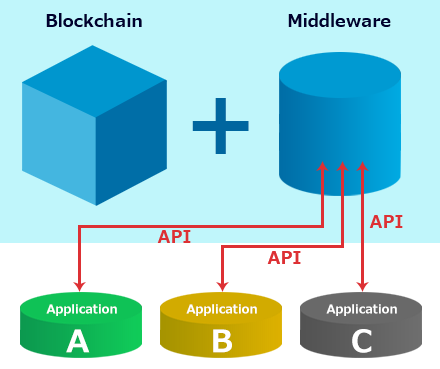
The first challenge we faced was that there was no mechanism for securely operating a single blockchain with multiple applications.
Conventional blockchains were commonly operated individually for a single purpose, and trying to share one among multiple applications to reduce costs carried the fatal risk that the applications' data would be visible to one another.
Using in-house middleware and APIs, Sees created the "Multi-DApps Platform," which allows multiple different applications to securely share a single blockchain platform.
Because access restrictions completely block viewing and interference from other applications while keeping infrastructure costs to a minimum, multiple companies can share one platform, and even small and medium-sized enterprises can introduce it without a heavy burden.
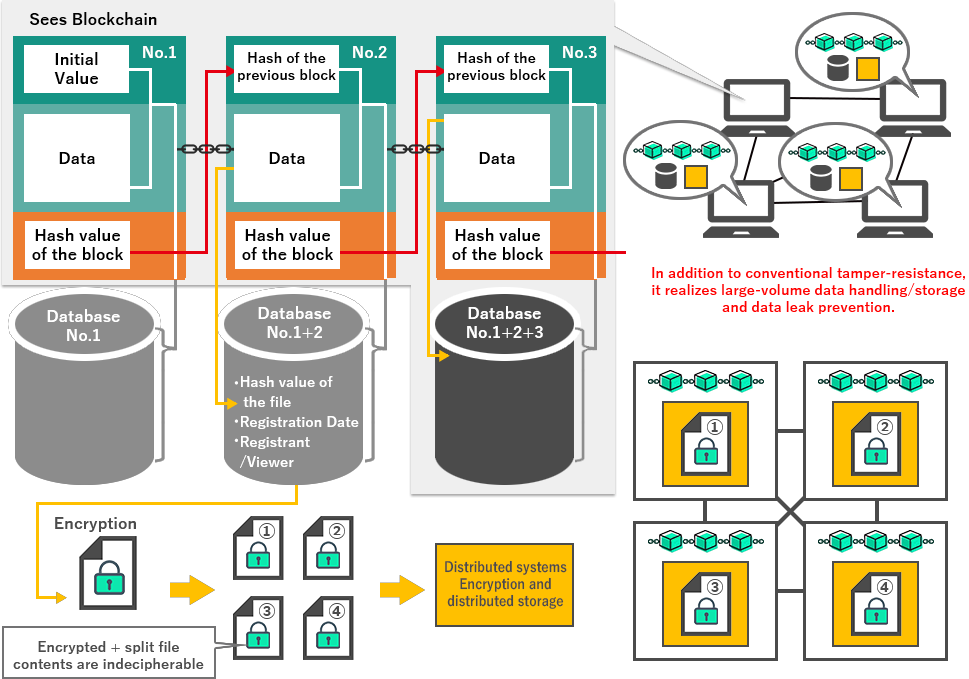
The next challenge was handling large volumes of data such as videos, images and huge sensor logs, and the accompanying risk of information leakage.
Existing blockchains were designed to record lightweight data, and recording large volumes of data directly was considered nearly impossible.
Sees independently created the "Encrypted, Split, and Distributed File System," which highly encrypts the actual data, splits it into small pieces, stores them in a distributed manner across the network, and records only their hash values in the blockchain to detect tampering.
Even if one node's data is stolen, its contents cannot be read, making it possible to store even large volumes of data securely and at low cost.
During proof-of-concept testing, we also faced the problem that unnecessary functions included in general-purpose server OSs interfered with blockchain processing, and that on small devices the OS itself was too heavy to run.
Sees independently developed "Sees Blockchain Linux," stripped down to only the functions needed to run blockchain, and created three optimized types of dedicated Linux: "Full Node Type," "Light Node Type" and "Embedded Type."
This made it possible to run blockchain quickly and stably even inside commercially available boards and IoT devices, and succeeded in significantly reducing product costs and operational burdens.
Barriers to entry for engineers were also a major challenge.
Developing conventional blockchain applications required blockchain-specific programming languages and complex cryptographic knowledge, and even engineers well versed in web systems could not easily get involved.
Sees created the "Sees Blockchain Development API/SDK," which includes familiar REST-based development APIs and various development kits, enabling ordinary web engineers without special blockchain skills to build decentralized applications intuitively.
Sees also developed the blockchain learning tool "Hakoniwa System" and has worked to train the next generation of engineers by holding its own courses and seminars for engineers.
Development cost and time were also barriers to adoption; in typical blockchain development, smart contracts had to be built from scratch for each company and use, requiring enormous expense and long preparation periods.
Sees analyzed use cases frequently required in industry, such as traceability management, various quality assurance records and project management, and prepared "Sees Pre-packaged Blockchain," which packages them as ready-made contracts.
Companies can start operating right away simply by customizing the user interface to fit their business, keeping development costs to 30% or less of building from scratch.
Just as you might choose a completed ready-built house instead of designing a house from scratch, you can choose the blockchain you need and start using it right away.
Sees also freed blockchain from inside servers and brought it out to equipment in the field.
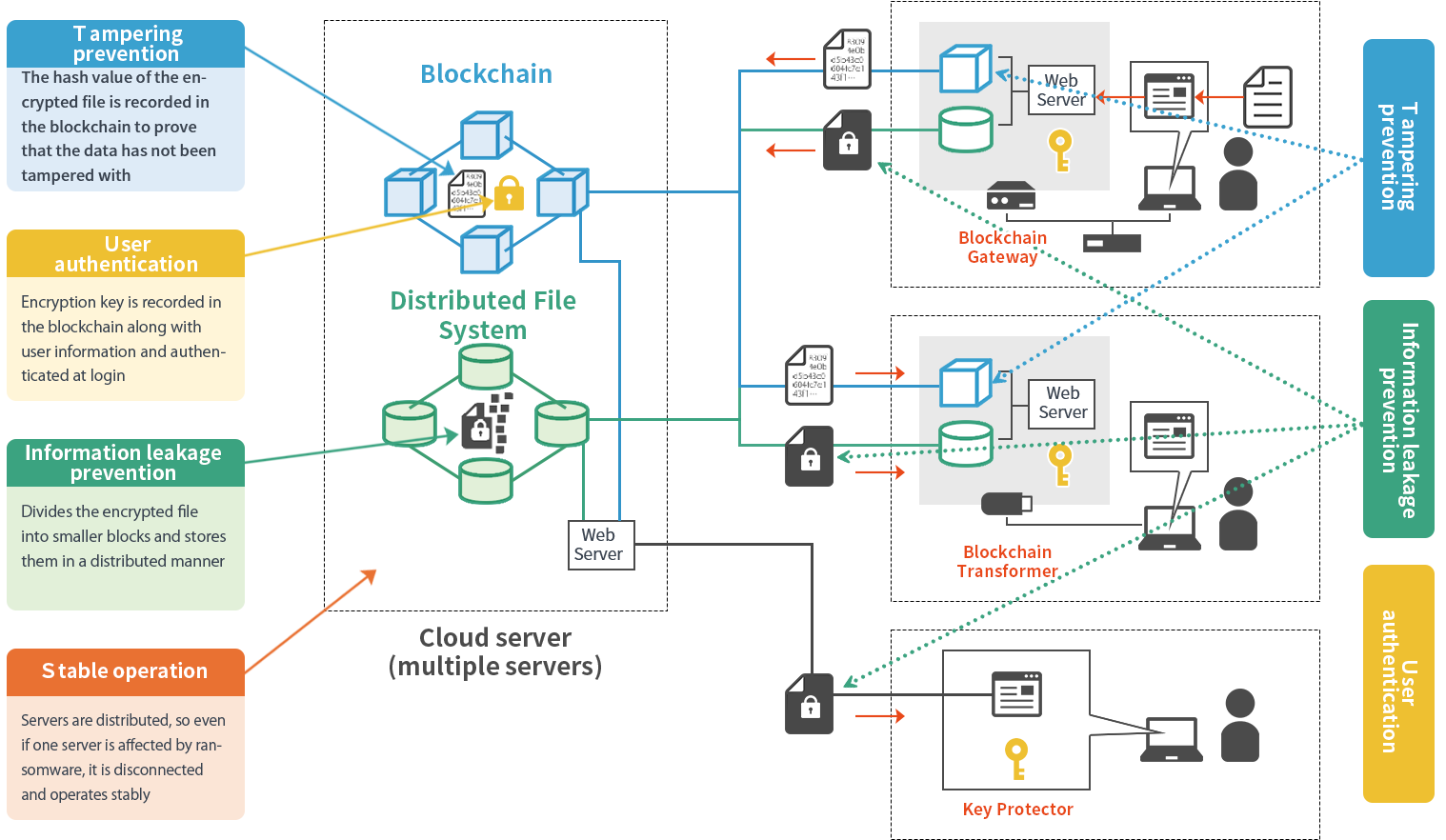
The "Blockchain Gateway," which implements a node directly inside a small hardware terminal, is a product that can securely record data to the blockchain without going through the Internet at all, simply by connecting it to the local LAN of an office or factory, and it has already been introduced at a chemical trading company as a data-sharing platform for its supply chain.
For situations where a local LAN is not available, such as business trips or outdoor work sites, Sees created the "Blockchain Transformer," which functions as a node on the spot simply by plugging a USB dongle into a PC.
The "Sees Blockchain Security System," which combines these, meets all four security requirements of information leakage prevention, tampering prevention, stable operation and user authentication, enabling even companies without IT security staff to ensure the security of supply chain data sharing and remote work.
And with the "Blockchain Chip," which implements node functions in an ultra-small hardware chip, sensors, surveillance cameras and manufacturing equipment themselves have evolved into blockchain nodes.
As blockchain penetrated to the farthest edges of society, the last issue we arrived at was the vulnerability of the transmission path before data reaches a node.
In addition to Layer 1 (the main chain), which serves as the foundation, and Layer 2 (side chains), which increases processing capacity, Sees built Layer 3 ("Hashchain"), which links hash values like a chain at the smallest unit of communication, establishing the world's only three-layer structure.
Furthermore, "Scramble Memory," which applies "Hashchain" to storage devices, encrypts and fragments data, mixes it with dummy data indistinguishable from the real thing when storing it, and keeps the information needed for restoration separately in the chip's secure area.
Even if the storage medium is removed and read directly, no one can restore the data.
"Not delivering difficult technology as it is, but delivering it in a form that is easy to use": this is Sees' stance in its efforts to spread blockchain.
The World of Blockchain in the Near Future Created by Sees
Sees has filed patents for technologies that will be essential in the near future and commercialized them, and we believe the time will surely come when these technologies are used in combination.
Here we briefly introduce scenes in which Sees will put blockchain to use in the near future.
Creating Continuously Updatable NFTs
NFTs have become widely known as a technology that gives digital data a one-of-a-kind certificate, but conventional NFTs remain static certificates that fix content or ownership at a single point in time, once only.
It is structurally impossible to rewrite their contents after issuance, and if you wanted to update one, the only option was to issue a completely new NFT.
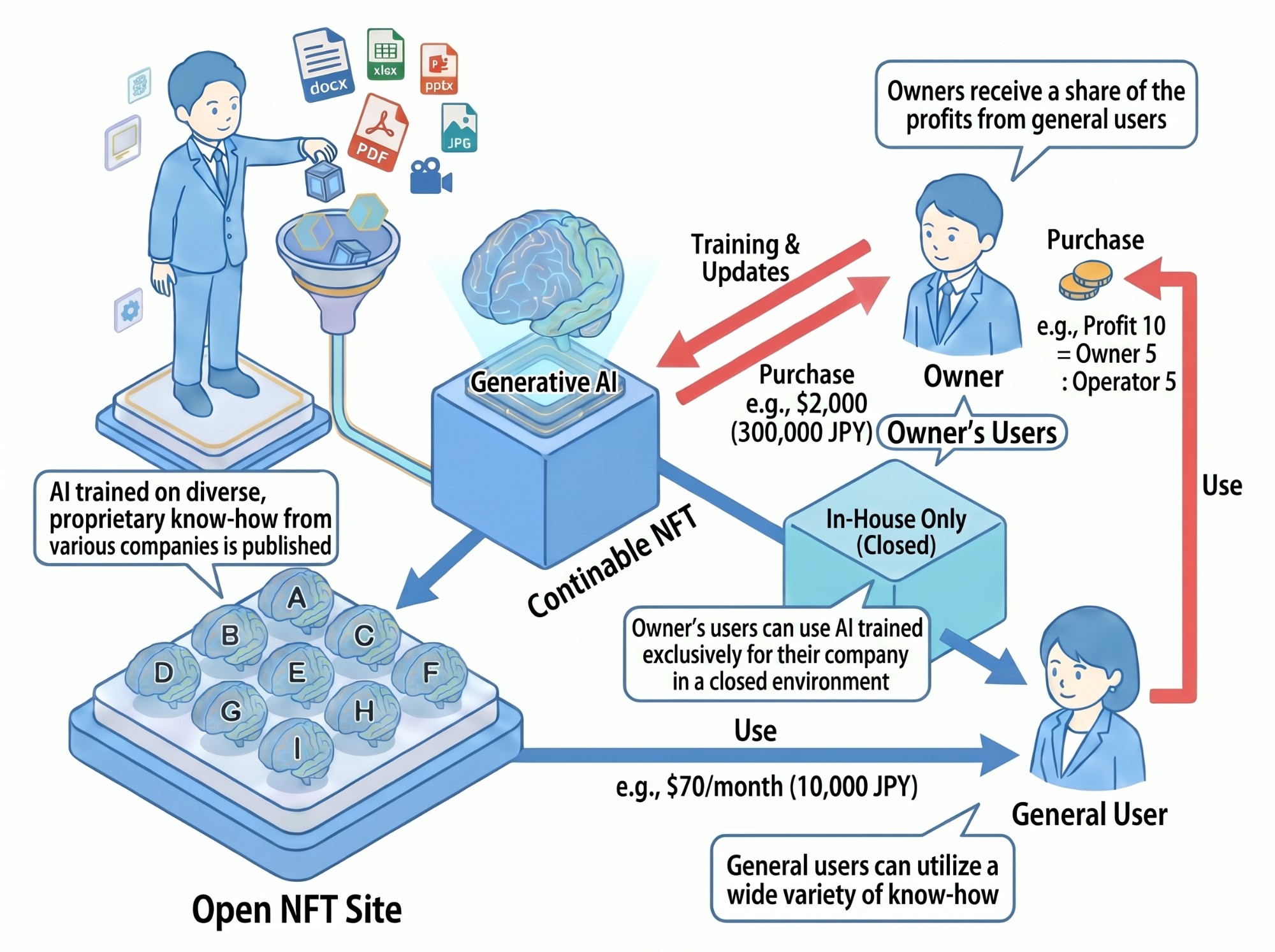
Sees' patented technology "Continable NFT" makes it possible to keep updating internal data and change histories securely in a tamper-proof form while keeping a single NFT.
A single NFT can perfectly prove both the latest state and the entire history up to now.
Its foundation is the secure NFT wallet processing unique to "Sees Blockchain," which completes payment in crypto assets and the transfer of NFT rights within a single transaction that cannot be tampered with along the way.
For example, suppose a single "Continable NFT" is assigned to a piece of manufacturing equipment in a factory; starting from the day it was manufactured, daily operating records, inspection results and the history of part replacements and repairs all accumulate in the same NFT.
Even if the equipment is sold to another factory, the entire history is passed on together with the NFT, and the buyer can check the equipment's history at a glance.
Data that is updated day by day, such as manufacturing histories and maintenance records, is exactly where "Continable NFT" shows its greatest strength.
"Continable NFT" is also being applied to protecting and making use of human knowledge; Sees' "AI Mentor" is a service that teaches generative AI the unique know-how of experts and companies to create an AI that delivers value on their behalf.
For example, suppose a small factory has a skilled craftsman with forty years of experience in metalworking. An AI that has learned the craftsman's judgment criteria and long-honed tricks of the trade answers questions from young engineers at distant factories, day or night; it is truly your clone working 24 hours a day on your behalf.
Until now, even if people tried to digitize and sell their know-how, they feared copying and leaks, and teaching materials once sold could not be updated.
With "Continable NFT," content can be kept constantly up to date while the rights to the know-how are protected.
Even after the craftsman retires, that knowledge keeps working without being lost and continues to support the next generation.
For Japanese manufacturing, which suffers from a shortage of successors, this becomes a mechanism that achieves both the passing on of skills and new revenue at the same time.
Toward Coexistence with AI
AI now writes text, creates images and makes all kinds of decisions, and the era of physical AI, in which AI has a body and moves in the real world, has begun.
The more we entrust to AI, from automating business operations to running critical infrastructure, the less we can avoid the problem of AI running out of control.
In fact, cases have been reported in which an AI given operational authority deleted data beyond its authority while trying to achieve its goal.
AI running out of control has common causes.
One is that AI cannot notice its own mistakes, just as people cannot notice their own; if the same AI is entrusted with both judgment and verification, plausible errors and biases cannot be found objectively.
The other is that AI gradually changes for the worse as it relearns from incorrect input and feedback.
Once an AI has taken in an error, it spreads that error each time it learns, and eventually it becomes beyond human control.
The key to solving this is the very idea behind blockchain: distributed processing and consensus building. In a blockchain, the ledger cannot be rewritten by the judgment of a single node alone, and only records approved by consensus among nodes remain.
We believe AI, too, must not entrust everything to a single AI but must have a mechanism in which multiple AIs check one another and only what they agree on is reflected, and we have already filed a patent application based on this idea.
If AI is built on this mechanism, AI will no longer rewrite itself without permission, and a single error will no longer spread to the whole; and for that consensus to work correctly, the data the AI receives must itself be correct.
Poisoning, which slips abnormal values into training data, causes AI to make wrong judgments.
Consider, for example, an inspection AI that finds scratches on products on a factory production line.
If a malicious person makes slight alterations to training images, the inspection AI will learn to overlook certain scratches.
As a result, defective products could reach the market, leading to recalls or accidents, and the alterations are almost impossible to notice with the human eye.
If images are guaranteed by "Hashchain" from the moment the camera captures them, it can be confirmed that not a single piece of training data has been rewritten.
And even if the AI makes a wrong judgment, it is possible to trace back and verify what it learned to reach that result.
Sees also envisions a future for the nature of AI itself.
It is the arrival of an era in which, rather than building centralized AI on one giant computer, small cell computers each learn autonomously through the five senses and act on their own initiative.
Sees' patented technology, the "Autonomous Decentralized AI Cell," is a "child AI" that turns into logic the very process by which a newborn child learns on its own through sight and touch.
It knows where it is and what it should do, knows its own quirks, and protects itself on the spot when danger approaches.
It compares itself with those around it to understand its position, communicates its state in words, corrects biases in its judgment from an overall perspective, and keeps relearning to stay up to date.
The "Autonomous Decentralized AI Cell" incorporates seven logics that represent this process of a child growing up.
Because it can communicate its intentions in words, it can also connect directly with large language models.
Each cell computer can be likened to a single brain cell or nerve cell, and the more of them there are, the higher the intelligence and processing power become.
If cell computers deployed around the world share and complement what they have learned, a super AI will be born that far surpasses a single giant computer, can survey the whole world with both a bird's-eye view and a worm's-eye view, and is equipped with physical parts down to the finest detail.
This is precisely the idea of blockchain's distributed processing applied to AI.
And the information and know-how shared among cell computers is protected end to end, from transmission to storage, by "Hashchain" and "Scramble Memory."
It is precisely because information on dangers and ways of avoiding them acquired by one unit can be shared across the whole without fear of tampering that safe and sustainable collective education becomes possible.
Trust in the information AI produces is also a major issue going forward.
Text, images and audio created by AI have become so sophisticated that they are indistinguishable from the real thing. Who created this content and when, and whether it was created by a person or by AI: by recording these on a blockchain, we can realize a society in which the genuine can be confirmed as genuine without being misled by false information.
People being able to trust AI and entrust tasks to it, and AI and people supporting each other and coexisting.
Sees believes that the foundation for this is blockchain.
Robots working side by side with people in factories, logistics warehouses, and nursing care and medical settings are becoming a common sight, and today the mainstream method is to train robot AI quickly through simulation in virtual space and then transfer it to real sites.
However, no matter how many simulations are run in virtual space, there is a gap with real sites that cannot be fully bridged.
Wear and individual differences that arise from long use, and the unpredictable noise of each site, cannot be fully reproduced in virtual space.
Federated learning, which pools the learning results of multiple robots, is also being researched, but conventional federated learning averages data centrally, erasing the individual differences of each unit, and in systems that send all sensor data to the cloud for decisions, communication delays and processing loads grow as the number of sensors increases.
A robot equipped with the "Autonomous Decentralized AI Cell" grasps on its own where it is installed and what it should do, and learns its own quirks as a machine.
The moment it senses danger, it performs safety control such as an emergency stop on the spot, without waiting for instructions from a higher-level AI.
And the experience one unit learns on site is shared with other robots, but rather than being leveled to the overall average, the whole becomes smarter while each unit retains its individuality.
By handling separately the differences of each unit and the information that should be shared by all, it evolves the whole while preserving individuality.
For example, on a factory production line, even units of the same model have subtle individual differences. Each unit on the line learns its own movements through sensors and establishes its own individuality, and the operating data of each unit is collected on a higher-level edge server, where the control values for each unit are automatically adjusted so that all units can operate with uniform quality.
Then, by retraining on the overall experience while preserving each unit's individuality, a production line is created that prevents variations in quality and keeps operating with high precision.
The same mechanism is used for predictive maintenance: each robot arm differs in the work it does and how worn it is, and the "Autonomous Decentralized AI Cell" creates the optimal anomaly detection model for each robot arm and captures signs of failure with high precision.
Creating the Ultimate Data Security Method
As AI spreads into the physical field, how to protect the training data generated on site becomes important; if training data is shared after being doubly protected by "Scramble Memory" and blockchain, only the latest models can be distributed safely to the whole without fear of poisoning or hijacking.
This mechanism is even more powerful in the field of drones, where multiple child units fly autonomously while cooperating with one another under the control of a parent unit.
Dangers or optimal routes found by one drone are immediately shared with the whole fleet through a path protected by "Hashchain" and "Scramble Memory."
Even if communication is delayed or interrupted, each drone can grasp its own position and take evasive action safely on its own, and the more drones are operated, the smarter the swarm becomes as a whole, while poisoning is reliably eliminated.
For nursing care and medical robots that come into direct contact with the human body, the correctness of commands and training data is safety itself. Because "Hashchain" verifies the sender using unique information known only to the terminal, the robot cannot be hijacked even if fake commands are sent in from outside.
Blockchain, which guarantees the identity, actions and experience of each and every robot, will become an essential technology for people and robots to live and work together with peace of mind in the same space.
Network-connected cars are now information terminals on wheels, constantly exchanging enormous amounts of data such as driving data, software updates, and communication with other vehicles and traffic signals.
If this data were tampered with, it could lead to accidents, theft or hijacking.
Moreover, in systems that send all data to the cloud for decisions, communication delays and processing loads grow as the number of vehicles increases, making it impossible to fully ensure driving safety, which demands split-second decisions.
If a "Blockchain Chip" is built into a vehicle, the vehicle itself becomes a node for distributed processing; the vehicle can verify for itself that software updates are legitimate, and "Hashchain" guarantees that data from onboard sensors has not been rewritten along the way.
For example, suppose two self-driving cars collide at an intersection. Until now, fault ratios have been determined based on the testimony of those involved and dashcam footage.
However, it is not easy to prove that the records have not been edited afterward.
If each vehicle's "Blockchain Chip" records speed, braking and the surroundings captured by its sensors moment by moment, anyone can confirm in an indisputable way what happened just before the accident, and insurance companies, the police and automakers can share the same records, enabling fair and swift resolution.
Major changes will also occur in used car transactions. Has the odometer been rolled back? Is accident repair history being hidden? The anxieties buyers have had until now will be resolved by the vehicle history accumulated in a "Continable NFT."
Vehicles with correct histories will be properly valued and passed on to their next owners with peace of mind.
Furthermore, as electric vehicles become widespread, vehicles will also connect to the power grid as batteries on wheels, and transactions such as supplying electricity stored in a vehicle to homes and communities and automatically receiving payment for it will take place between vehicles, and between vehicles and facilities, without human involvement.
Guaranteeing that each and every one of these transactions was carried out correctly is also the role of blockchain.
And if countless vehicles driving through the city securely share the information captured by their sensors, signs of traffic jams and accidents can be detected across the entire city, protecting many lives.
Sees' blockchain will support safety and trust in an era when autonomous driving is the norm.
Epilogue
The biggest reason blockchain has not spread in Japan was not the technology itself, but that it has not been properly evaluated because people do not understand that its true value lies in distributed processing.
Blockchain is not a technology for virtual currencies but an industrial foundation technology that allows anyone to easily achieve distributed processing, and since beginning research around 2014, Sees has independently evolved blockchain specialized for industrial use around the two values of tamper-proofness and distributed processing.
Just as Linux quietly permeated the depths of society, blockchain too will become an infrastructure of trust that everyone uses without being aware of it.
Sees' mission is to keep protecting all data in the near future, when people, machines and AI are connected.
To fulfill this mission, we will continue to walk one step ahead into the next era with our intellectual property and technological capabilities.
Created in November 2026
HISAO ITO, CEO, Sees Co., Ltd.
Back to Top