



















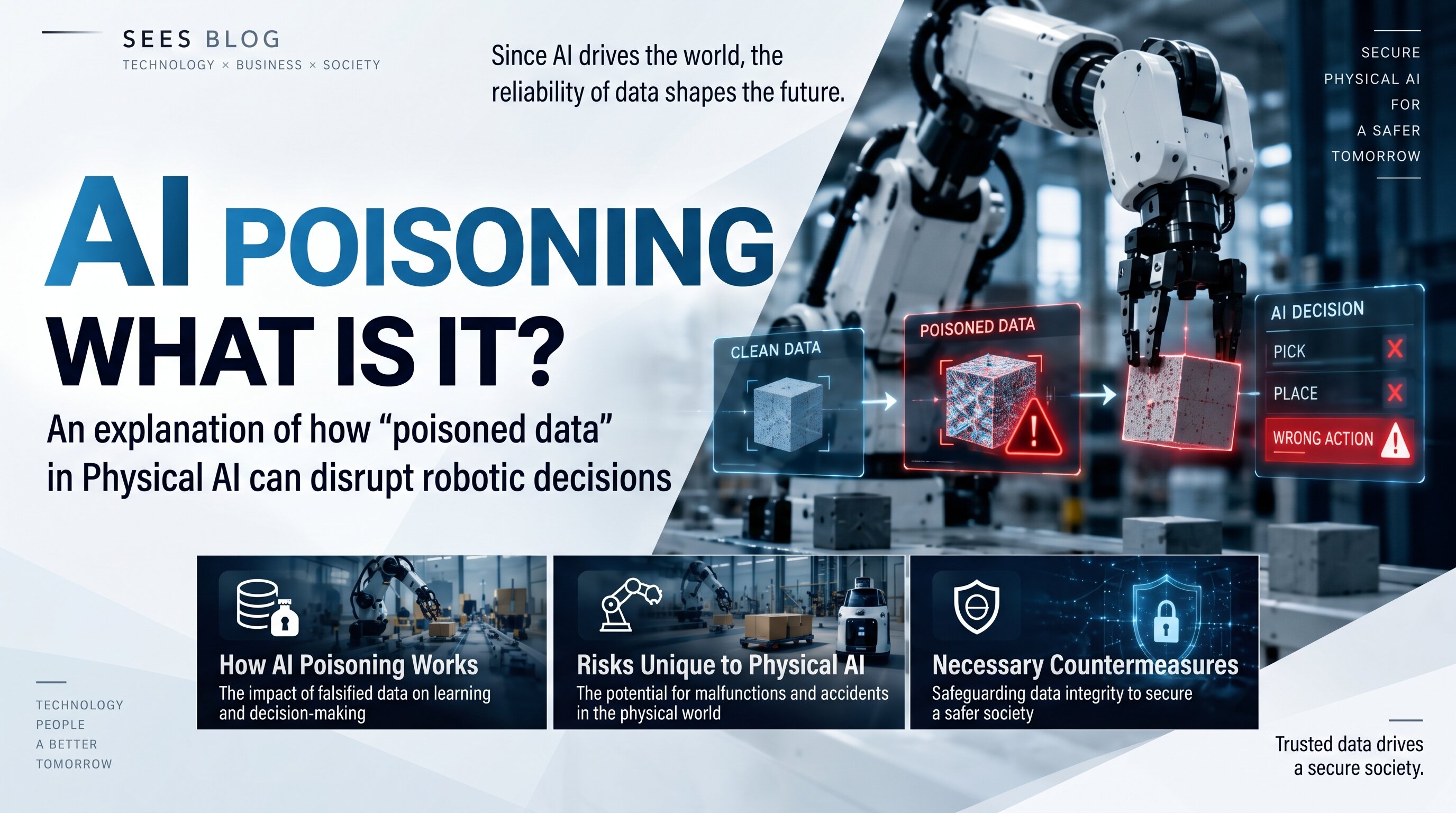
As AI becomes ubiquitous, "AI Data Poisoning" is gaining significant attention as a major cyber security risk.
In AI Data Poisoning, malicious or corrupt data is injected into the information that AI models train on or process, directly corrupting the AI's inference, judgments, and outputs.
While this poses serious threats to Generative AI, it carries even more critical real-world implications for Physical AI--where artificial intelligence directly controls robots, drones, autonomous vehicles, and industrial machinery.
In Physical AI, AI decision-making relies not only on offline training data, but also on real-time input telemetry, such as camera feeds and sensor data during live operations. Consequently, securing the AI model alone is insufficient; we must protect the entire data supply chain--including data origin, provenance, and payload integrity.
In Physical AI systems, AI decisions directly trigger physical movements and mechanical actions in the real world.
Furthermore, these systems continuously stream telemetry from cameras, temperature gauges, LiDAR, microphones, vibration sensors, and positioning modules.
- What AI Data Poisoning is
- The difference between AI Data Poisoning and Prompt Injection
- Why data corruption is critical for Physical AI
- Training-Time Security vs. Runtime Data Security
- The importance of Data Provenance and Data Integrity
- Verifying data payload integrity using Hash Chains
- The relationship between Chip Fingerprints and Device Trust
- The concept of the Physical AI Trust Loop
- What Is AI Data Poisoning?
- Why AI Data Poisoning Is So Dangerous
- Differences Between AI Poisoning and Prompt Injection
- Why Securing the "Training Phase" Alone Is Not Enough in Physical AI
- What Happens If a Robot's Sensor Telemetry Is Spoofed?
- The 3 Stages of Data Corruption in Physical AI
- The Risk of Continuously Training on Corrupted Data
- Data Provenance: The Key to Mitigating AI Poisoning
- Why Data Integrity Must Pair with Data Provenance
- Why Security Cannot Focus Exclusively on the AI Model
- Verifying Data Tampering via Hash Chains
- Tracking Data Origin with Chip Fingerprints
- Isolating and Quarantine-Filtering Corrupted Data
- The Physical AI Trust Loop
- Why Data Security Grows Critical as AI Autonomy Increases
- Key Security Checkpoints for Deploying Physical AI
- Summary
- Frequently Asked Questions
What Is AI Data Poisoning?
AI Data Poisoning is an umbrella term for cyber attacks that intentionally manipulate data used for AI training or inference to corrupt the behavior, judgments, or outputs of AI models.
A primary variant is Data Poisoning.
By intentionally injecting false or malicious samples into AI training datasets, attackers can cause severe behavioral distortions, such as:
- Misclassifying Object A as Object B
- Triggering abnormal decisions under specific edge-case conditions
- Blinding the AI to specific targets or obstacles
Because AI models learn patterns from massive datasets, what an AI learns depends heavily on the quality of data it receives. Therefore, AI security must focus on data trustworthiness alongside model architecture.
Why AI Data Poisoning Is So Dangerous
In conventional cyber attacks, adversaries usually attempt to breach systems and execute commands directly.
AI Data Poisoning operates differently. Attackers do not need to hack the robot or command it to "turn right."
By corrupting the data streams that the AI processes, attackers manipulate the AI into making flawed or hazardous decisions autonomously.
In the AI era, security parameters must expand beyond system infrastructure to encompass the data streams fed into AI models.
AI Poisoning vs. Prompt Injection
Although sometimes confused, AI Data Poisoning and Prompt Injection are fundamentally different threat vectors.
| Parameter | AI Data Poisoning | Prompt Injection |
|---|---|---|
| Primary Target | Training datasets, runtime telemetry, inference data | Direct user prompts and LLM instructions |
| Attack Method | Corrupting datasets or sensor feeds | Injecting malicious text prompts or system overrides |
| Impact | Systemic model corruption, flawed inferences | Bypassing safety guardrails in dialogue models |
| Physical AI Relevance | Critical across real-time sensor streams and training pipelines | Relevant for natural language AI agents and interfaces |
Unlike standard LLMs, Physical AI systems must process continuous, real-time sensor feeds captured directly from the physical environment.
Why Securing the "Training Phase" Alone Is Not Enough in Physical AI
In traditional Data Poisoning research, securing offline training datasets is the primary focus.
However, Physical AI systems continuously ingest massive volumes of real-world operational data post-deployment during live runtime.
If live sensor feeds are spoofed or corrupted, adversaries can distort AI decisions without ever attacking the AI model itself.
What Happens If a Robot's Sensor Telemetry Is Spoofed?
Consider an Autonomous Mobile Robot (AMR) navigating a busy warehouse floor.
Under normal conditions, proximity sensors generate telemetry indicating: "Person detected 2 meters ahead."
However, if an attack or hardware error corrupts the feed to read "Path clear ahead," the AI model will make navigation decisions based on that false telemetry.
In this scenario, the AI model itself is completely uncompromised, yet it produces a hazardous decision because its input data was corrupted.
This demonstrates why Physical AI security cannot merely ask "Is the AI functioning correctly?", but must answer: "Can we trust the data the AI relies on for its decisions?"
The 3 Stages of Data Corruption in Physical AI
In Physical AI systems, data security risks can be analyzed across three distinct stages:
Datasets used during initial model development. Corrupting this data distorts baseline decision thresholds in the core AI model.
Training Data → AI Model
Real-time feeds used for live operational decisions--including optical video, LiDAR point clouds, temperature, vibration, and positioning telemetry.
Sensor → Runtime Data → AI Inference
Field data collected during operations and fed back into continuous learning loops to update AI models post-deployment.
Field Data → Re-Training → Updated AI Model
If corrupted runtime telemetry is stored and fed into continuous re-training pipelines, runtime data corruption bleeds back into offline model training.
The Risk of Continuously Training on Corrupted Data
A defining characteristic of Physical AI is its continuous operational interaction with the real world.
As autonomous systems utilize field experience for ongoing model updates, they form continuous Learning Loops:
While this loop drives continuous performance improvements, it also introduces systemic security vulnerabilities.
If corrupted telemetry enters the Learning Loop undetected, it causes not just isolated real-time errors, but long-term structural bias and corruption in future AI model versions.
Data Provenance: The Key to Mitigating AI Poisoning
To prevent corrupt data from entering AI models, systems must implement Data Provenance.
Simply put, Data Provenance refers to the ability to track the complete origin, lineage, and processing history of a data payload.
In Physical AI, establishing data provenance requires verifying parameters such as:
- Which specific robot or machine generated the telemetry?
- Which specific physical sensor unit captured the data?
- What exact timestamp was the reading recorded at?
- Under what environmental parameters was it captured?
- Which software and firmware version processed the data?
- What network transmission path did the payload traverse?
Without clear provenance, determining whether a data sample is safe for AI training or inference becomes impossible.
Combining Data Provenance with Data Integrity
Knowing where data originated is insufficient if the payload was modified during transmission or storage.
Therefore, Data Provenance must be paired with Data Integrity.
Physical AI security requires an integrated framework combining data origin tracking, payload tamper-proofing, and hardware device authentication.
Why Security Cannot Focus Exclusively on the AI Model
Conventional AI poisoning defenses emphasize model monitoring, outlier detection, and dataset sanity checks within the AI stack.
However, Physical AI security must protect data before it ever reaches the AI engine.
Verifying Data Tampering via Hash Chains
At SEES Inc., we are researching and developing Hash Chain technology to guarantee data integrity across Physical AI architectures.
By cryptographically linking sequential data blocks using hash outputs, Hash Chains enable continuous verification to ensure:
- Data payloads remain completely unaltered since creation
- Sequential packet order and stream continuity remain intact
Because Physical AI devices generate continuous time-series telemetry streams, verifying that incoming data has not been modified post-generation is a critical defense requirement.
Tracking Data Origin with Chip Fingerprints
Even with data integrity guaranteed, a fundamental question remains: "Which physical device generated this data in the first place?"
This highlights the necessity of Device Authenticity and Device Identity.
SEES Inc. is developing Chip Fingerprint technology, which utilizes unique micro-variations in semiconductor physical structures to establish hardware-bound identity.
Combining hardware identity with software hash chains creates an unbroken chain of trust verifying both the originating hardware device and payload integrity.
Isolating and Quarantine-Filtering Corrupted Data
In Physical AI environments with active re-learning loops, identifying suspicious data and filtering it out before re-training is essential.
Data payloads that meet all origin, provenance, and integrity criteria, making them safe for inference and re-training pipelines.
Telemetry failing provenance or integrity verification, which must be quarantined to prevent model poisoning.
Flagging and isolating unverified data prevents corrupt samples from degrading future AI models.
Furthermore, maintaining complete audit trails mapping which datasets trained specific AI models simplifies root-cause analysis when operational anomalies occur.
The "Trust Loop" Concept for Physical AI
Unidirectional security measures are insufficient for autonomous Physical AI ecosystems.
SEES Inc. envisions Physical AI security as a closed-loop framework--a Trust Loop spanning hardware devices, data streams, AI inference, physical actions, and continuous re-learning.
As autonomous AI systems learn continuously from the real world, establishing complete verifiability for input data becomes a foundational requirement.
Why Data Security Grows Critical as AI Autonomy Increases
When AI acts as a passive analytics tool, human operators review outputs before executing final decisions.
However, as Physical AI advances, systems will autonomously execute continuous Sense → Decide → Act loops without real-time human intervention.
Where human oversight of every real-time decision is unfeasible, ensuring that incoming AI data is verified and trustworthy becomes essential for physical safety.
Key Checkpoints for Deploying Physical AI Systems
When deploying Physical AI, enterprises must audit the complete data supply chain alongside AI model performance.
- Can the exact originating source of AI input data be verified?
- Can telemetry be conclusively authenticated to legitimate hardware devices?
- Is real-time tamper detection active across data feeds?
- Are training and runtime inference datasets strictly segregated and audited?
- When utilizing field telemetry for re-training, can complete data provenance be traced?
- Can suspicious or unverified data be quarantined automatically?
- In the event of an operational failure, can the specific input data that triggered the decision be audited?
Enterprises must manage AI models and the data supply chain as an integrated security unit.
Summary | Mitigating AI Poisoning Starts at the Data Entry Point
AI Data Poisoning is a major security risk that corrupts AI inference and behavior by manipulating input data.
In Physical AI, this threat cannot be restricted to offline training datasets.
Real-world telemetry streams--including camera video, sensor readings, location data, vibration, acoustics, and temperature--serve as the direct inputs for real-time AI decision-making.
Furthermore, when field telemetry feeds continuous re-training loops, a direct cycle emerges: Runtime Data → Training Data.
SEES Inc. is advancing R&D to build a comprehensive Physical AI Trust Infrastructure by combining Chip Fingerprints for Device Trust, Hash Chains for Data & Transmission Trust, Scramble Memory for Data at Rest, and Autonomous Distributed AI Cells.
Beyond asking "How smart is the AI?", we must answer: "What is the AI learning from, and to what extent can we trust that data?"
Frequently Asked Questions About AI Data Poisoning
What is AI Data Poisoning?
AI Data Poisoning refers to attacks that intentionally manipulate data used for AI training or runtime inference to distort the model's behavior, judgments, or physical outputs.
What is Data Poisoning?
It is an attack method where malicious or erroneous samples are injected into AI training datasets to corrupt the model's underlying classification or decision logic.
Is AI Data Poisoning the same as Prompt Injection?
No. Prompt Injection manipulates AI behavior via adversarial instructions in natural language inputs, whereas Data Poisoning corrupts training datasets or runtime telemetry feeds.
Why is AI Data Poisoning particularly dangerous in Physical AI?
Because AI decisions in Physical AI trigger real-world physical movement by robots and autonomous machinery. In addition, systems continuously process real-time sensor streams that are vulnerable to runtime data corruption.
What is Data Provenance?
Data Provenance is the capability to trace and audit the complete origin, device lineage, timestamp, and processing history of a specific data payload.
How can enterprises mitigate AI Data Poisoning?
Mitigation requires a multi-layered defense: dataset validation, data provenance tracking, zero-trust access control, anomaly detection, payload integrity verification, and continuous model monitoring. For Physical AI, hardware device authentication and real-time transmission tamper-proofing are also essential.