



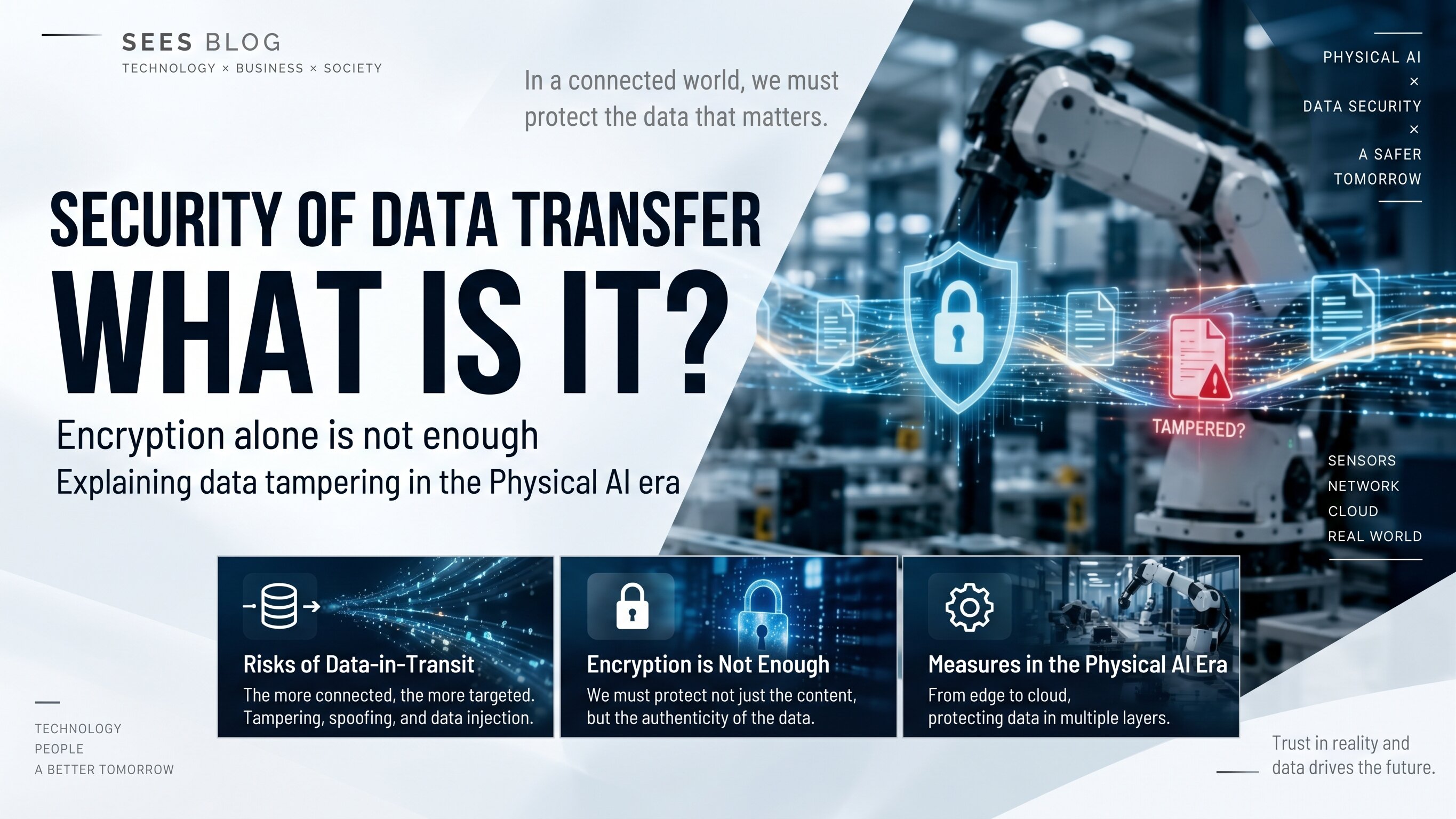
With the widespread adoption of AI, robotics, IoT, and smart factories, vast amounts of real-world data are being transmitted across networks to AI models and cloud systems.
In Physical AI, sensor-captured telemetry travels across transmission paths to feed AI decision engines, which in turn drive mechanical controllers and physical actions.
Data Transfer Security is an overarching framework to protect and verify confidentiality, authenticity, integrity, and sequential continuity from the moment data is generated by sensors or devices until it reaches AI engines, servers, or control units. Beyond securing transmission channels, it focuses on making the data utilized by AI fully verifiable.
- What Data Transfer Security is
- The difference between encryption and Data Transfer Security
- Why Data in Transit is critical for Physical AI
- Potential security threats during data transmission
- Verifying data authenticity, integrity, and continuity via Hash Chains
- Key differences between Hash Chains and Blockchain
- Balancing Data Transfer Security with ultra-low latency requirements
- Integrating Device Trust with Data Trust
- What Is Data Transfer Security?
- Why It Is Essential for Physical AI
- Differences Between Encryption and Data Transfer Security
- What Can Happen to Data in Transit?
- The Reliability of "Data in Transit"
- Moving Beyond "Prevention" to "Verifiability"
- What Is a Hash Chain?
- Differences Between Hash Chains and Blockchain
- Balancing Data Transfer Security and Low Latency
- Combining Device Trust with Data Trust
- Industries Requiring Data Transfer Security
- Data as a Direct Target for Security
- Summary
- Frequently Asked Questions
What Is Data Transfer Security?
Data Transfer Security is an approach that protects and verifies data confidentiality, authenticity, integrity, and sequential continuity as telemetry generated by sensors or devices travels across networks and intermediate devices to reach AI models, servers, or control units.
In a smart factory, for example, data traverses the following path:
In this architecture, preventing unauthorized reading (eavesdropping) is only part of the challenge.
- Can data authenticity be conclusively verified?
- Has data been altered or tampered with in transit?
- Have any data packets been lost or dropped?
- Has legitimate data been substituted with false payloads?
- Is sequential continuity and timing integrity maintained?
- Can the data be linked strictly to an authorized hardware device?
Why Data Transfer Security Is Critical for Physical AI
In Physical AI, artificial intelligence does not observe the physical world directly.
Cameras, temperature sensors, pressure gauges, LiDAR, microphones, and positioning units translate physical phenomena into digitized data streams for AI processing.
For AI models, sensor telemetry is the primary input for evaluating physical reality. If incoming inputs are compromised, even an uncompromised AI model will issue unsafe decisions.
For instance, imagine a factory sensor detects "Motor Vibration: Abnormal." If that telemetry is tampered with in transit to read "Normal," the receiving AI model will process the "Normal" signal and decide that no corrective action is needed.
Although the AI model operated flawlessly, a critical failure occurs because the input state was corrupted before reaching the AI engine.
How Data Transfer Security Differs from Encryption
When considering network security, "encryption" is often the first mechanism that comes to mind. While encryption is essential, encryption is not synonymous with verifying data authenticity and integrity.
| Perspective | Primary Objective |
|---|---|
| Encryption | Hides data payload content from unauthorized third parties (Confidentiality). |
| Authentication | Confirms the identity of communication peers or systems. |
| Authenticity Verification | Validates that data and devices are authentic and generated by authorized sources. |
| Integrity Verification | Ensures data has remained unaltered and untampered since creation. |
| Data Transfer Security | Comprehensively protects and verifies data end-to-end from generation to receipt. |
If an authorized sensor node is compromised at the edge, it may generate corrupted data that is then legitimately encrypted and transmitted. While encryption ensures confidentiality during transit, it cannot guarantee that the sensor reading accurately reflects physical reality.
What Can Happen to Data in Transit?
In Physical AI and IoT environments, data traverses multiple network hops and intermediate systems. During transit, data can be corrupted by intentional cyber attacks or system glitches.
Data payload values are modified in transit--e.g., changing "100°C" to "50°C"--causing AI decision engines to miscalculate physical states.
Legitimate telemetry is replaced with false payloads--e.g., substituting current alarm states with cached normal historical telemetry to mask active failures.
Intermittent packet loss or intentional dropping corrupts time-series data streams relied upon by AI inference models.
The sequential timing of packets (A → B → C → D) is disrupted (A → C → B → D), distorting time-dependent AI processing.
Stale, previously captured telemetry packets are retransmitted to trick control systems into reacting to outdated conditions.
Why "Data in Transit" Reliability Is Paramount in Physical AI
In data security frameworks, data states are generally categorized as follows:
Data stored locally in databases, memory, or storage media.
Data actively moving across networks or communication channels.
Data being actively processed by system CPUs, GPUs, or AI models.
In Physical AI, Data in Transit is a critical focal point because data flows bidirectionally between sensors, AI engines, and actuators.
If an AI correctly issues an "Emergency Stop" command, but that control signal is corrupted during transmission to the motor controller, the physical machine will fail to stop.
Moving Beyond "Prevention" to End-to-End "Verifiability"
In complex operational environments, assuming that every network attack or packet disturbance can be 100% prevented is unrealistic.
Therefore, security architectures must establish mechanisms to independently verify incoming data before it is trusted by downstream systems.
- When was this specific data packet generated?
- Can the source authenticity of the data be proven?
- Which physical device generated the data payload?
- Has the payload been modified or altered during transit?
- Is sequential and temporal continuity preserved with adjacent data?
Establishing these verification metrics enables systems to evaluate incoming data conditionally based on cryptographic proof rather than trusting network feeds implicitly.
What Is a Hash Chain?
SEES Inc. has developed proprietary Hash Chain technology designed to verify data authenticity, integrity, and sequential continuity in real time.
A Hash Chain cryptographically links sequentially generated data points using cryptographic hash outputs.
By embedding preceding hash values into subsequent data blocks, continuous data streams form an unbroken cryptographic chain.
If any intermediate payload is altered or reordered, subsequent hash calculations will fail, enabling instant detection of data tampering or packet loss.
Furthermore, SEES's Hash Chain incorporates cryptographic Seeds to verify source data authenticity alongside stream integrity.
- Authenticity: Validates that data originated from an authorized software/system process.
- Integrity: Confirms data payload has not been modified or corrupted in transit.
- Continuity: Verifies that the sequential chain of streaming packets remains intact.
By combining Seed-based authenticity verification with cryptographic hash linkage, SEES Hash Chain technology transforms raw streaming telemetry into fully verifiable data streams.
Differences Between Hash Chains and Blockchain
Although Hash Chains and Blockchains share cryptographic primitives, they are distinct architectures optimized for different use cases.
| Parameter | Hash Chain | Blockchain |
|---|---|---|
| Basic Architecture | Cryptographic hash linkage of data streams | Distributed block-based ledger architecture |
| Consensus Mechanism | Not required for stream verification | Requires distributed consensus mechanisms (PoW, PoS, etc.) |
| Primary Purpose | Real-time verification of data authenticity, integrity, and continuity | Decentralized record-keeping, asset tracking, and state agreement |
| System Overhead | Lightweight and suitable for low-latency edge applications | Includes network consensus overhead and distributed node storage |
| Physical AI Fit | Optimized for high-speed streaming telemetry verification | Applied based on throughput demands and decentralization needs |
Because Physical AI processing often requires real-time response loops, security mechanisms must be evaluated on whether they can maintain required system low-latency thresholds.
Balancing Data Transfer Security with Ultra-Low Latency
A key engineering challenge in Physical AI is optimizing Security × Latency.
Industrial robotics, autonomous vehicles, commercial drones, semiconductor manufacturing systems, and micro-actuators demand millisecond or sub-millisecond execution loops.
If cryptographic verification steps introduce excessive processing overhead, system performance degrades, making real-time deployment unfeasible.
Security architectures must achieve robust data protection and verification while preserving required real-time response speeds.
Integrating Data Authenticity with Device Authenticity
In Physical AI environments, verifying data authenticity is only half the equation; confirming that the underlying hardware generating the data is authentic is equally critical.
SEES Inc. combines software-level data verification via Hash Chains with hardware-level identity verification using Chip Fingerprint technology, which leverages unique physical variations in silicon microstructures.
Chip Fingerprint technology establishes unique hardware identity at the semiconductor root to anchor Device Trust.
Hash Chain technology verifies software-level authenticity alongside data payload integrity and sequential continuity.
Integrating these layers enables continuous verification across key parameters: "Is the hardware authentic?", "Is the data source authentic?", "Has the payload been modified in transit?", and "Is sequence continuity intact?"
Industries Requiring Data Transfer Security
The principles of Data Transfer Security extend beyond specialized AI deployments to any operational domain relying on critical machine-to-machine telemetry.
Secures massive data feeds moving continuously between field sensors, PLCs, industrial robotics, edge nodes, and AI analytics engines.
Guarantees telemetry integrity for optical cameras, LiDAR, radar, and vehicle-to-everything (V2X) communications.
Protects streaming flight telemetry, spatial positioning, optical feeds, and remote navigation control commands.
Ensures patient telemetry and robotic surgical assistance data remain authentic, untampered, and fully traceable.
Provides tamper-evident audit trails for thermal, temporal, and processing parameters to support quality control and regulatory compliance.
Combines high-speed data payload verification with ultra-low latency execution across precision fabrication equipment.
Data as a Direct Target for Security in the Physical AI Era
Traditional cybersecurity focused primarily on securing network perimeters, physical terminals, servers, and user access accounts.
In the Physical AI era, the data itself becomes a primary target for security and verification.
Regardless of AI model capability, if the authenticity, integrity, and sequential continuity of input telemetry cannot be verified, evaluating whether the AI is receiving true representation of physical reality is impossible.
Summary | Shifting from "Transmitting Data" to "Verifying Data"
In Physical AI systems, vast telemetry streams collected from physical sensors feed AI decision engines, which then transmit actionable control commands back to physical machinery.
While encryption is indispensable, shielding data from third-party eavesdropping is fundamentally different from verifying data authenticity, integrity, and continuity.
- Can device and hardware authenticity be conclusively verified?
- Can the source authenticity of the data stream be confirmed?
- Has the payload remained unaltered since creation?
- Are there missing or dropped telemetry packets?
- Is sequential timing and temporal order preserved?
- Does the data meet verification criteria required for AI input?
SEES Inc. is building a robust Physical AI Trust Infrastructure by integrating core technologies including Hash Chains, Chip Fingerprints, and Scramble Memory.
Beyond asking "What decision did the AI make?", we must answer: "To what extent can we verify the authenticity, integrity, and continuity of the data the AI relied on for its decision?"
Frequently Asked Questions About Data Transfer Security
What is Data Transfer Security?
It is a security framework designed to protect and verify data confidentiality, authenticity, integrity, and sequential continuity as telemetry moves from originating devices to AI engines, servers, or control systems.
How does Data Transfer Security differ from encryption?
Encryption hides data contents from unauthorized third parties. Data Transfer Security extends beyond confidentiality to verify data origin authenticity, tamper detection, packet loss, reordering, and stream continuity.
Why is Data Transfer Security essential for Physical AI?
Because Physical AI relies on sensor telemetry to make decisions that trigger physical actions. If input telemetry is tampered with in transit, even a healthy AI model can issue hazardous control commands.
What is a Hash Chain?
It is a cryptographic structure that links sequential data points using hash outputs. SEES Hash Chain technology combines Seed-based authenticity verification with continuous stream integrity and continuity verification.
Can Hash Chains verify data authenticity?
Yes. SEES Hash Chain technology uses cryptographic Seeds to verify software and data authenticity. When paired with Chip Fingerprints for hardware verification, it provides comprehensive Device Trust and Data Trust.
How do Hash Chains differ from Blockchain?
Hash Chains focus on linking sequential data streams cryptographically without requiring distributed consensus overhead, making them lightweight and ideal for high-speed streaming telemetry in Physical AI.
Which industries require Data Transfer Security?
Industries relying on machine-to-machine telemetry and physical automation--including smart manufacturing, robotics, automotive, commercial drones, semiconductors, healthcare, food processing, and critical infrastructure.