



























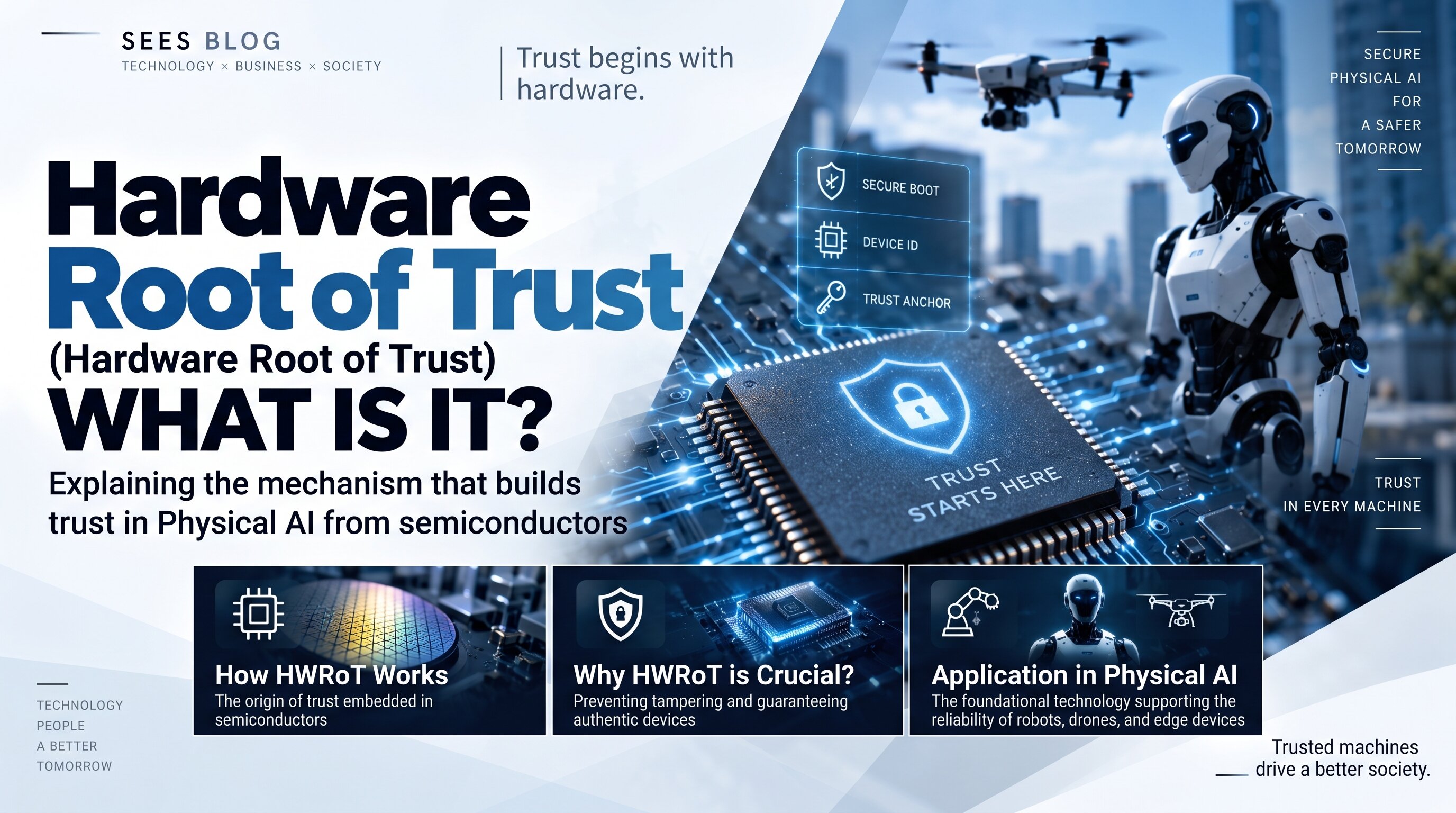
The deployment of Physical AI--where artificial intelligence perceives the real world, makes decisions, and actuates physical machinery across robotics, drones, autonomous vehicles, and smart factories--is expanding rapidly.
In Physical AI architectures, securing the AI model alone is insufficient; we must establish end-to-end trust across the entire pipeline--including sensors, semiconductors, physical devices, network communications, and data feeds--before information ever reaches the AI engine.
Where, then, should this "trust" begin?
The foundational concept that addresses this question is the Hardware Root of Trust (HRoT).
A Hardware Root of Trust (HRoT) is a hardware-anchored foundation of trust used to build overarching security architectures.
In Physical AI, establishing semiconductors and physical hardware as the initial root of trust is essential to building an unbroken Chain of Trust spanning device identification, authentication, data verification, network transmission, AI inference, and mechanical actuation.
- What Hardware Root of Trust (HRoT) is
- Why physical hardware serves as the ultimate root anchor for trust
- The distinction between Root of Trust and Chain of Trust
- Key security capabilities enabled by Hardware Root of Trust
- The relationship between HRoT, TPMs, Secure Elements, and PUFs
- How Machine Identity connects with Hardware Root of Trust
- Establishing Hardware Authenticity via Chip Fingerprints
- Why Hardware Root of Trust is vital for Physical AI
- Extending trust seamlessly from Device Trust to Data Trust
- What Is Hardware Root of Trust?
- Why a Hardware "Root" Is Essential
- Root of Trust vs. Chain of Trust
- Primary Security Roles of Hardware Root of Trust
- Technologies Implementing Hardware Root of Trust
- The Relationship Between PUFs and HRoT
- Connecting Machine Identity with HRoT
- Why HRoT Is Essential in Physical AI
- Hardware Authenticity via Chip Fingerprints
- Extending Hardware Root of Trust to Data Trust
- Building Physical AI Trust Infrastructure
- Industries Requiring Hardware Root of Trust
- Summary
- Frequently Asked Questions
What Is Hardware Root of Trust?
A Hardware Root of Trust (HRoT) is a hardware-anchored foundation of trust designed to underpin system security and verifiability.
Literally translated, "Root of Trust" represents the starting root or anchor from which all higher-level security claims are evaluated.
In compute platforms and embedded devices, software architectures consist of multiple stacked layers: hardware, firmware, operating system (OS), applications, and AI models.
To verify higher software layers, system architectures require an unalterable lower-level mechanism to validate those software components.
Establishing the ultimate root anchor of security directly in physical hardware--or circuits immutably tied to hardware--is the core design principle behind a Hardware Root of Trust.
When asking "What serves as the ultimate starting point for our security architecture?", HRoT establishes physical silicon as the immutable foundation of trust.
Why a Hardware "Root" Is Essential
In security engineering, validating that "a software component is authentic" requires checking it against cryptographic rules or verification engines.
However, what happens if the verification engine itself is compromised or tampered with?
If systems validate that engine using a second software layer, the problem recurs: "What guarantees the integrity of the second software layer?"
To prevent infinite regression, systems require an immutable baseline: a physical anchor that serves as the unquestioned starting point of trust.
Root of Trust vs. Chain of Trust
Understanding Hardware Root of Trust requires distinguishing between a Root of Trust and a Chain of Trust.
| Parameter | Root of Trust | Chain of Trust |
|---|---|---|
| Definition | The immutable starting anchor for building trust | The process of extending trust sequentially from the root to higher layers |
| Primary Role | Provides the initial, uncompromised trust foundation | Accumulates verified steps to expand the scope of trust |
| Analogy | The root of a tree | An unbroken chain extending from the root |
| Physical AI Role | Establishes hardware silicon as the starting anchor | Links trust: Device → Data → AI → Action |
Primary Security Roles of Hardware Root of Trust
Hardware Root of Trust does not refer to a single standalone commercial product or isolated feature.
Depending on overall system architecture, hardware-anchored trust foundations support a wide variety of security capabilities across the platform:
Leverages hardware-bound unique attributes or keys to anchor device authentication.
Safeguards private cryptographic keys inside tamper-resistant hardware boundaries.
Cryptographically authenticates firmware and OS images during boot to ensure only authorized code executes.
Measures booted components and records cryptographic hashes to verify platform state post-boot.
Provides cryptographically signed proof enabling external remote systems to verify platform health.
Utilizes silicon-level attributes to confirm that physical hardware components are genuine.
Importantly, a Hardware Root of Trust mechanism is not required to implement every one of these features simultaneously.
Rather, HRoT acts as the baseline anchor from which designers engineer specific required security capabilities.
Technologies Implementing Hardware Root of Trust
Multiple hardware technologies can implement or contribute to a Hardware Root of Trust, depending on cost, performance, and platform requirements.
Trusted Platform Module. A dedicated security coprocessor used for key protection, platform measurement, and remote attestation.
A tamper-resistant hardware chip designed to isolate cryptographic secrets and run secure applets.
Physical Unclonable Function. Leverages silicon manufacturing micro-variations for key derivation and unique hardware signatures.
Integrated security subsystems built directly into System-on-Chip silicon providing secure boot and hardware key management.
TPMs, Secure Elements, and PUFs exhibit different technical trade-offs. Systems combine or deploy these hardware primitives to construct an immutable foundation of trust according to application needs.
The Relationship Between PUFs and Hardware Root of Trust
A PUF (Physical Unclonable Function) exploits microscopic physical variations inherent in silicon manufacturing.
Even semiconductors produced using identical masks and fabrication processes exhibit subtle microscopic physical differences.
Extracting these unique physical traits enables hardware engines to derive unclonable device identities and cryptographic keys on-demand without storing raw secrets in flash memory.
Consequently, PUF technology represents a powerful building block for constructing a silicon-anchored Hardware Root of Trust.
Connecting Machine Identity with Hardware Root of Trust
In Physical AI, managing Machine Identity--establishing verifiable identities for non-human entities like robots, sensors, and edge nodes--is a paramount requirement.
Machine Identity answers "which machine is communicating?", enabling automated authentication and access governance.
By anchoring Machine Identity in a Hardware Root of Trust, systems permanently bind machine identities to unclonable physical silicon.
While Machine Identity addresses "what identity this machine claims", Hardware Root of Trust answers "where the trust underpinning that identity is anchored."
Why Hardware Root of Trust Is Essential in Physical AI
In Physical AI architectures, AI decision-making does not remain confined to digital cloud environments.
AI inferences drive real-world physical actions--causing industrial robots to move, commercial drones to adjust flight paths, autonomous vehicles to navigate, and factory machinery to execute commands.
Under these conditions, protecting the AI model alone is insufficient.
- Is the transmitting device genuine?
- Is the physical hardware verified and uncompromised?
- Can the integrity of firmware and OS software layers be verified?
- Can incoming telemetry be conclusively linked to an authentic hardware device?
- Can data payload authenticity, integrity, and continuity be proven?
- Can verified inputs be fed directly into AI decision engines?
Constructing this end-to-end Chain of Trust from the bottom up requires a Hardware Root of Trust as its foundation.
Hardware Authenticity via Chip Fingerprints
At SEES Inc., we are developing proprietary Chip Fingerprint technology that extracts unique physical silicon variations from semiconductors.
By leveraging unique silicon micro-variations, Chip Fingerprints identify individual devices to establish Hardware Authenticity at the physical root layer.
Extending Hardware Root of Trust to Data Trust
While confirming hardware authenticity is essential, it does not complete the trust model for Physical AI on its own.
Systems must also verify the telemetry payloads created and transmitted by those devices.
SEES Inc. uses Chip Fingerprints to confirm hardware authenticity at the physical layer, while employing software Hash Chains with cryptographic Seeds to verify data authenticity, payload integrity, and stream continuity.
Established via Chip Fingerprints to verify physical hardware authenticity.
Verified via Hash Chains + Seeds to confirm data/software source authenticity.
Validated via Hash Chains to ensure payloads remain unaltered post-generation.
Confirmed via Hash Chains to guarantee time-series stream sequence integrity.
From Hardware Root of Trust to Physical AI Trust Infrastructure
In Physical AI, security cannot be achieved by relying on any single isolated technology.
Starting from a hardware root, trust must extend continuously across devices, telemetry streams, communication paths, AI inference engines, and physical controllers.
SEES Inc. conceptualizes this multi-layered framework linking trust across every operational layer as Physical AI Trust Infrastructure.
Rather than treating the AI model as the starting point, systems must anchor trust in physical semiconductors and extend it sequentially: Device → Data → Transmission → AI → Action.
Industries Requiring Hardware Root of Trust
Hardware Root of Trust is essential across all sectors deploying large-scale connected devices where hardware-level attestation and software integrity are required.
Authenticates robotic controllers, embedded sensor arrays, and onboard processing compute nodes.
Establishes the foundational Device Trust for flight controllers, navigation hardware, and video feeds.
Anchors hardware-based trust across connected ECUs, gateways, and ADAS sensor suites.
Underpins platform trust for industrial robots, PLCs, field sensors, and edge compute nodes.
Enables chip-level component attestation, hardware authentication, and secure provisioning.
Establishes silicon-anchored trust for scale-out edge deployments operating in unmonitored environments.
Summary | Building Physical AI Trust Starting from Semiconductors
A Hardware Root of Trust (HRoT) is an immutable hardware-anchored foundation of trust used to build overarching system security.
By establishing HRoT as the root anchor, systems build a Chain of Trust through firmware, operating systems, applications, and AI models to secure the entire platform.
In Physical AI, this framework must expand further to encompass hardware devices, streaming data payloads, networks, AI inference, and physical actuation.
- Anchor initial trust in physical semiconductors and hardware
- Identify and authenticate machines using cryptographic Machine Identity
- Verify physical hardware authenticity at the silicon layer
- Validate data source authenticity, payload integrity, and stream continuity
- Protect and verify telemetry payloads during network transmission
- Feed verified, untampered data into AI decision engines
- Translate verified AI decisions into safe, real-world physical actuation
SEES Inc. utilizes Chip Fingerprints to establish hardware authenticity and software Hash Chains with cryptographic Seeds to verify data source authenticity, payload integrity, and sequence continuity.
Frequently Asked Questions About Hardware Root of Trust
What is a Hardware Root of Trust?
It is an immutable hardware-anchored starting point for building system security. Using this hardware root, platform architectures establish a Chain of Trust through firmware, operating systems, and software layers.
What is the difference between Root of Trust and Chain of Trust?
Root of Trust is the foundational starting anchor for security. Chain of Trust is the process of extending cryptographic verification sequentially from that root anchor to higher software components.
Is a TPM the same as a Hardware Root of Trust?
Not necessarily. A TPM (Trusted Platform Module) is a specific secure coprocessor component used for key protection, measurements, and attestation, acting as a technical building block for implementing a Hardware Root of Trust.
Is a PUF a Hardware Root of Trust?
A PUF (Physical Unclonable Function) exploits silicon manufacturing variations to derive hardware keys and signatures. While not a complete HRoT architecture on its own, a PUF serves as a key hardware primitive used alongside authentication protocols to implement a Root of Trust.
How does HRoT relate to Machine Identity?
Machine Identity provides unique, verifiable credentials to non-human entities like robots and edge nodes. Hardware Root of Trust anchors Machine Identity directly to physical silicon, ensuring credentials cannot be cloned onto unauthorized hardware.
Why is Hardware Root of Trust vital for Physical AI?
Because Physical AI relies on edge telemetry to make autonomous decisions that execute physical actions in the real world. Anchoring trust in hardware guarantees that telemetry originates from authentic, uncompromised physical devices.
How do Chip Fingerprints fit into Hardware Root of Trust?
SEES Chip Fingerprint technology extracts unique physical silicon characteristics from semiconductors to establish hardware identity and verify Hardware Authenticity, serving as the silicon-level root anchor for Device Trust.
Does a Hardware Root of Trust alone secure a Physical AI ecosystem?
No. HRoT provides the initial root anchor. Comprehensive Physical AI security requires extending trust across device authentication, data payload integrity, stream continuity, transmission security, AI model protection, and actuation safety.