



















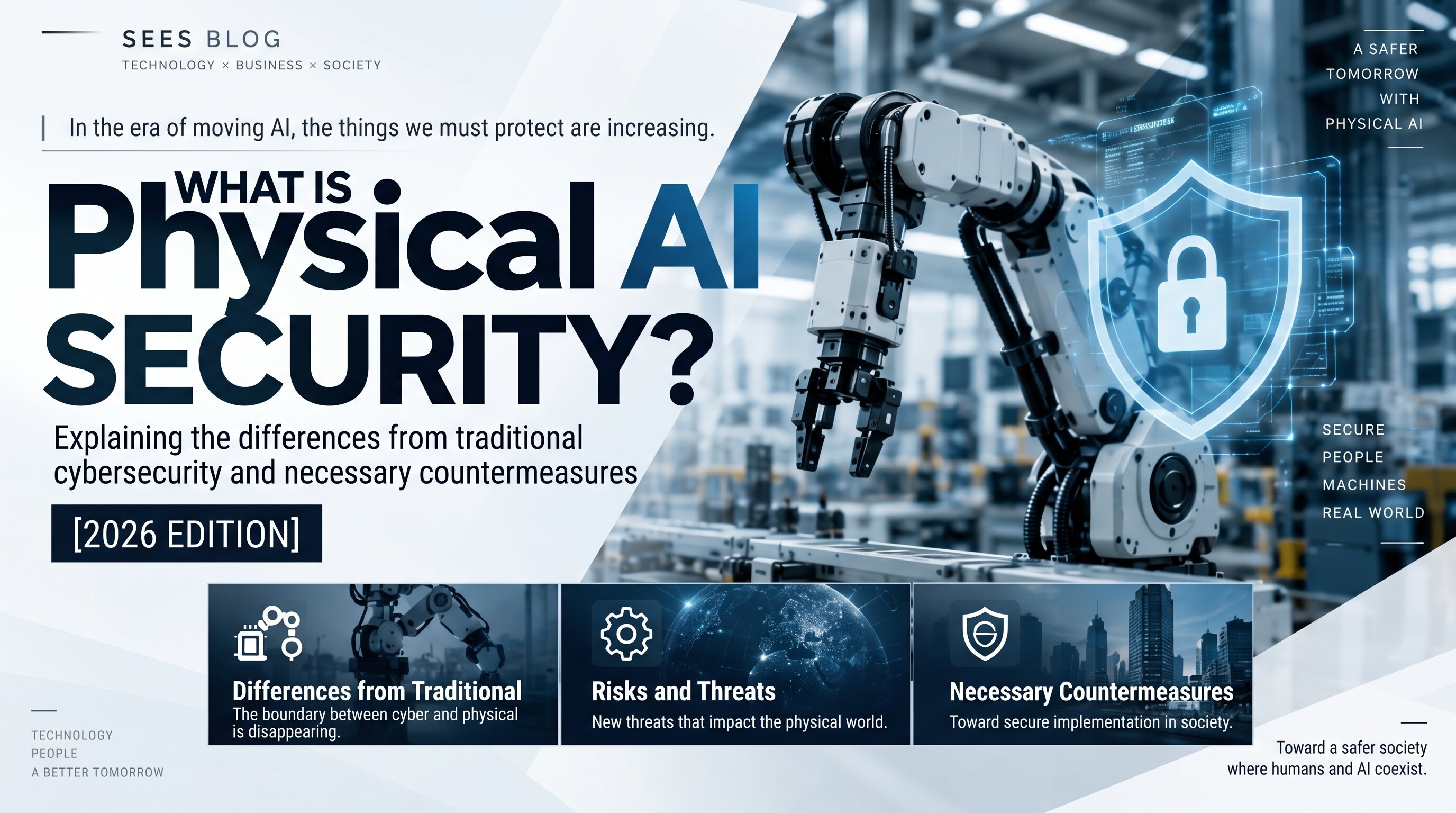
As Physical AI expands into humanoids, industrial robotics, autonomous driving, drones, and smart factories, artificial intelligence is perceiving the real world, making decisions, and operating physical machinery. Alongside this rapid expansion, Physical AI Security is emerging as a critical priority.
In Physical AI systems, traditional cybersecurity measures--such as preventing network intrusions, securing servers, and protecting user accounts--are no longer enough on their own.
Physical AI Security is an overarching security approach that ensures safety and trust across the entire ecosystem--spanning not only AI models, but also sensors, devices, communications, data, AI processing, control commands, and physical actions.
- What Physical AI Security is
- Key differences from traditional cybersecurity
- Major security risks in Physical AI
- Why encryption alone is insufficient
- The importance of Device Trust and Data Trust
- The 5 core elements of Physical AI Trust
- The concept of Physical AI Trust Infrastructure
- The necessity of balancing security with ultra-low latency
- What Is Physical AI Security?
- Why a New Security Paradigm Is Needed
- Differences from Traditional Cybersecurity
- 5 Major Security Risks in Physical AI
- Why Encryption Alone Cannot Protect Physical AI
- Understanding Data Authenticity
- Identity Management for Machines
- The 5 Core Elements of Physical AI Trust
- Physical AI Trust Infrastructure
- Security R&D at SEES
- Security and Real-Time Requirements
- Which Industries Require Physical AI Security?
- 7 Key Checkpoints for Enterprises
- From Perimeter Defense to Continuous Trust Verification
- Summary
- Frequently Asked Questions
What Is Physical AI Security?
Physical AI Security refers to a comprehensive security framework designed to guarantee safety and trustworthiness across the entire Physical AI chain--including sensors, physical devices, communication channels, data streams, AI models, control logic, and physical actuators.
A simplified data flow of Physical AI operates as follows:
For instance, an Autonomous Mobile Robot (AMR) navigating a factory floor gathers ambient data using cameras, LiDAR, and proximity sensors. The AI processes this information to recognize obstacles and nearby personnel, determining whether to stop, decelerate, or reroute.
The crucial realization here is that a flawlessly working AI model does not automatically guarantee the overall safety of the Physical AI system.
If data fed into the AI is tampered with or spoofed, the AI will make decisions based strictly on those compromised inputs.
In Physical AI, we must treat AI model security and the trustworthiness of input data as distinct considerations.
Why Physical AI Demands a New Security Paradigm
Conventional IT infrastructure faces various cyber risks such as data breaches, unauthorized access, malware, and data tampering. Physical AI remains vulnerable to these threats as well.
However, the critical difference is that issues originating in cyberspace can directly trigger unintended physical movements in the real world.
Consequently, Physical AI requires an integrated strategy bridging Cybersecurity, AI Security, Functional Safety, and Data Integrity.
Differences Between Traditional Cybersecurity and Physical AI Security
The differences between the two paradigms are summarized below:
| Parameter | Traditional Cybersecurity | Physical AI Security |
|---|---|---|
| Primary Targets | PCs, servers, accounts, networks, etc. | Sensors, edge devices, data streams, AI models, control units, etc. |
| Primary Data Types | Business data, personal information, financial records, etc. | Video feeds, telemetry, coordinates, pressure/temp, control signals, etc. |
| Primary Actors | Humans, applications, cloud services | Humans, AI models, robots, autonomous machinery |
| Potential Impact | Data leaks, service outages, financial loss | Information theft plus physical damage, injury, or hardware manipulation |
| Authentication Targets | Users, systems, managed devices | Users, systems, devices, field sensors, controllers |
| Key Focus Areas | Confidentiality, Integrity, Availability (CIA) | CIA plus origin verification, hardware trust, physical safety |
| Real-Time Needs | Varies by application requirements | Essential for systems tied to real-time physical control |
Understanding CIA Triad
Protects information from unauthorized access or eavesdropping.
Ensures data has not been altered, modified, or tampered with unexpectedly.
Guarantees that systems and data remain operational and accessible when needed.
While the CIA triad remains foundational in Physical AI, security architectures must extend further to verify data sources and protect physical operations in real time.
5 Major Security Risks in Physical AI
Securing Physical AI requires evaluating multiple attack surfaces across the pipeline--from initial data generation down to physical execution.
1. Device Impersonation
Physical AI deployments rely on vast networks of connected sensors and edge nodes. Verifying whether data originates from a legitimate, authorized device is essential.
If an adversary impersonates a legitimate sensor and injects forged telemetry into the system, it can distort AI decision-making.
2. Sensor Data Spoofing & Manipulation
AI models do not perceive the physical environment directly; they process digitized sensor readings.
If an actual temperature reading of "100°C" is tampered to read "50°C", the AI will make decisions based on 50°C, leading to potential thermal runaway or system failure.
Even the most advanced AI model will make unsafe decisions if its input feeds are spoofed or corrupted.
3. In-Transit Data Tampering
Data in Physical AI environments travels across multiple hops--from sensors to edge nodes, networks, AI inference engines, and motor controllers.
- Data payload alteration
- Packet insertion or substitution
- Replay attacks using stale data
- Packet loss or intentional dropouts
- Disruption of time-series order
This highlights the necessity of Data Integrity--ensuring that data received by the AI can be verified as completely unaltered since its creation.
4. Direct Attacks on AI Models
Attacks directed specifically at AI models and inference engines must also be addressed in Physical AI.
- Training data poisoning
- Unauthorized model access or theft
- Model tampering and weight manipulation
- Adversarial input attacks
- Inference process manipulation
However, AI Security alone does not equal Physical AI Security. Even if an AI model is secure, compromises at the sensor, communication, or actuation levels will jeopardize the entire system.
5. Control Command Tampering
The outputs generated by Physical AI directly drive mechanical control logic. Therefore, the AI → Control transmission path is a critical asset.
For example, if an AI outputs a "STOP" command, but the signal is intercepted and altered to "FORWARD" before reaching the actuator, a physical incident will occur despite correct AI inference.
Why Encryption Alone Cannot Protect Physical AI
While data encryption is fundamental to modern network security, its primary function is keeping data contents hidden from third parties.
Physical AI requires answers to additional security questions:
- Which specific hardware node produced this data?
- Is the originating hardware properly authenticated?
- Was the data modified prior to or during transmission?
- Are there missing data packets or replayed transmissions?
- Is the sequential continuity of time-series data intact?
If an attacker compromises a physical sensor node at the hardware level, that node could generate fraudulent data that is subsequently encrypted and transmitted legitimately.
Encryption guarantees confidentiality, but it cannot prove that sensor values accurately reflect physical reality. Confidentiality, Integrity, and Authenticity must be combined into a cohesive framework.
Understanding "Data Authenticity" in Physical AI
A core concept in Physical AI security is Data Authenticity.
Data Authenticity ensures that data can be conclusively verified as originating from an authorized source hardware node, and that it has remained uncompressed and unmodified since creation.
Did this reading originate from the authorized sensor on Production Line A?
Is this frame stream generated by the primary optical sensor of the specified robot?
Are these coordinates linked strictly to the authentic GNSS unit of the target drone?
It is important to note that verifying data origin is distinct from validating sensor hardware calibration. Physical AI security requires separate mechanisms for origin verification, data integrity, and sensor health monitoring.
Identity Management: Shifting Focus from Humans to Machines
Zero Trust architecture operates on the principle of "never trust, always verify," requiring authentication for every access request regardless of network position.
In Physical AI, sprawling ecosystems of autonomous machinery--including robots, sensors, edge nodes, AI engines, and micro-actuators--interact continuously without human intervention.
Never Trust the Data. Extending Zero Trust principles to the machine and data layer of Physical AI.
Consequently, identity management must evolve beyond human users and software accounts to encompass device and machine identity management.
The 5 Core Elements of Physical AI Trust
At SEES Inc., we view Physical AI security not as isolated point solutions, but as a continuous chain of trust across five distinct levels:
Identifies and authenticates hardware nodes to verify device legitimacy at the hardware root.
Validates data integrity, source provenance, and time-series continuity against unauthorized changes.
Protects and verifies in-transit data feeds against tampering, packet dropping, or replaying.
Ensures the integrity of both the AI model architecture and the real-time input streams used for inference.
Secures control logic signals sent from AI modules to physical actuators and mechanical controllers.
A failure at any single link in this chain can compromise the integrity and safety of the entire Physical AI system.
The Concept of "Physical AI Trust Infrastructure"
SEES Inc. defines the architecture supporting end-to-end reliability across these components as Physical AI Trust Infrastructure.
Rather than applying fragmented security controls to individual layers, our goal is to build a unified infrastructure capable of verifying trust across all layers of the Physical AI stack simultaneously.
Security R&D at SEES for Physical AI
To realize a robust Trust Infrastructure for the Physical AI era, SEES Inc. is actively developing several advanced core technologies:
Chip Fingerprint
Utilizes physical micro-variations inherent in semiconductor manufacturing process to establish unique, unforgeable hardware identities. Serves as the root anchor for Device Trust.
Given the massive deployment of sensors and edge devices in Physical AI, chip-level identification and authentication are indispensable.
Hash Chain
Physical AI deployments continuously stream high-volume sensor telemetry to AI models. To secure these streams, SEES has developed Hash Chain technology that cryptographically links sequential data packets.
By incorporating cryptographic Seeds, our Hash Chain technology verifies not only packet sequence and integrity, but also data origin authenticity in real time.
- Authenticity: Validates that data was generated by an authorized, authentic hardware process.
- Integrity: Confirms data has not been altered or tampered with in transit.
- Continuity: Ensures packet ordering is maintained without missing or injected frames.
Scramble Memory
Physical AI security must extend to data stored locally on edge devices and autonomous robots (Data at Rest).
SEES is developing Scramble Memory to protect local memory contents from physical extraction or tampering, embedding Data at Rest protection into the Trust Infrastructure.
The Imperative of Real-Time, Low-Latency Security
In Physical AI security architectures, Latency represents a critical engineering constraint.
In autonomous vehicles, industrial robotics, drones, and cobots, transmission or processing delays directly impair physical control loops, creating safety hazards.
Security mechanisms must be engineered to execute without compromising the ultra-low latency demands of real-time physical control systems.
Industries Requiring Physical AI Security
Physical AI Security is not limited to robotics; it is essential across every sector where AI perception influences real-world physical machinery.
Interlinks industrial robots, PLCs, field sensors, optical cameras, AI models, MES, and cloud platforms into unified control loops.
Autonomous driving and ADAS rely on multi-sensor fusion; maintaining high data authenticity is vital for passenger safety.
Handles real-time feeds of position metrics, video feeds, altitude, velocity, flight telemetry, and flight commands.
Secures fleet communications and navigation data among autonomous mobile robots (AMRs) operating in shared fulfillment spaces.
Protects energy grids, transit networks, and water distribution systems as AI-driven automation assumes control of public operations.
7 Security Checkpoints for Enterprises Deploying Physical AI
When adopting Physical AI, enterprises must look beyond AI model benchmarks and evaluate security readiness from edge sensors to physical control systems.
Can connected devices and edge nodes be uniquely identified and authenticated?
Can input data be reliably traced back to its specific originating sensor or device?
Can the system instantly detect data modifications made during transmission?
Can sequential continuity and timing integrity of time-series data be guaranteed?
Is local memory secured against physical or digital extraction at the edge?
Are outgoing control signals from AI to physical actuators protected from alteration?
Do security verification steps maintain required real-time response thresholds?
Shifting Paradigms: From Perimeter Defense to Continuous Verification
Traditional cybersecurity relied heavily on perimeter defense--building firewalls to separate internal corporate networks from external threats.
In today's environment of cloud services, remote operations, and massive IoT deployments, organizations have shifted toward Zero Trust architectures--verifying every request regardless of network location.
In Physical AI, this continuous verification model must expand further across the physical layer:
- Never trust hardware devices implicitly
- Never trust incoming sensor data implicitly
- Never trust network transmissions implicitly
- Verify both inputs fed into AI and control outputs issued by AI
Summary | Securing "What the AI Believes"
With the widespread adoption of Physical AI, artificial intelligence is transitioning from purely digital tasks to controlling physical machinery and critical infrastructure in the real world.
In this new reality, securing the AI model alone is no longer sufficient.
At SEES Inc., we define this essential foundation as Trust Infrastructure.
- Chip Fingerprint
- Hash Chain
- Scramble Memory
- Autonomous Distributed AI Cell
Beyond asking "How capable is the AI?", we must answer: "To what extent can we verify the devices and data that the AI relies on for its decisions?"
Frequently Asked Questions About Physical AI Security
What is Physical AI Security?
Physical AI Security is an integrated security paradigm that protects not only AI models, but the entire physical ecosystem--including sensors, devices, networks, data feeds, control modules, and mechanical actuators.
How does Physical AI Security differ from traditional cybersecurity?
Because AI decisions trigger physical actions in the real world, Physical AI Security extends traditional IT protection to include sensor data origin, real-time telemetry integrity, control signal validation, and functional safety.
Why is Data Authenticity so critical in Physical AI?
AI models make decisions strictly based on incoming data streams. If input data is spoofed or manipulated, even an uncompromised AI model will issue unsafe or hazardous physical control commands.
Is data encryption enough to keep Physical AI secure?
No. While encryption ensures message confidentiality, it cannot verify whether the originating device is legitimate, whether the sensor readings are accurate, or whether the data was altered before encryption.
How does Zero Trust relate to Physical AI?
Zero Trust's core premise--"never trust, always verify"--applies directly to Physical AI. It requires extending verification principles to hardware devices, field sensors, continuous data streams, and control commands.
What threats are anticipated in Physical AI environments?
Key threats include device impersonation, sensor spoofing, in-transit data tampering, adversarial AI attacks, training data poisoning, and control command interception.
What is Physical AI Trust Infrastructure?
It is a holistic security framework conceptualized by SEES Inc. that establishes continuous, end-to-end verification across devices, communications, data streams, AI inference, and mechanical actuators.
Which industries need Physical AI Security most?
Industries deploying autonomous physical systems--including smart manufacturing, autonomous driving, commercial drones, logistics, healthcare robotics, and critical infrastructure.