
























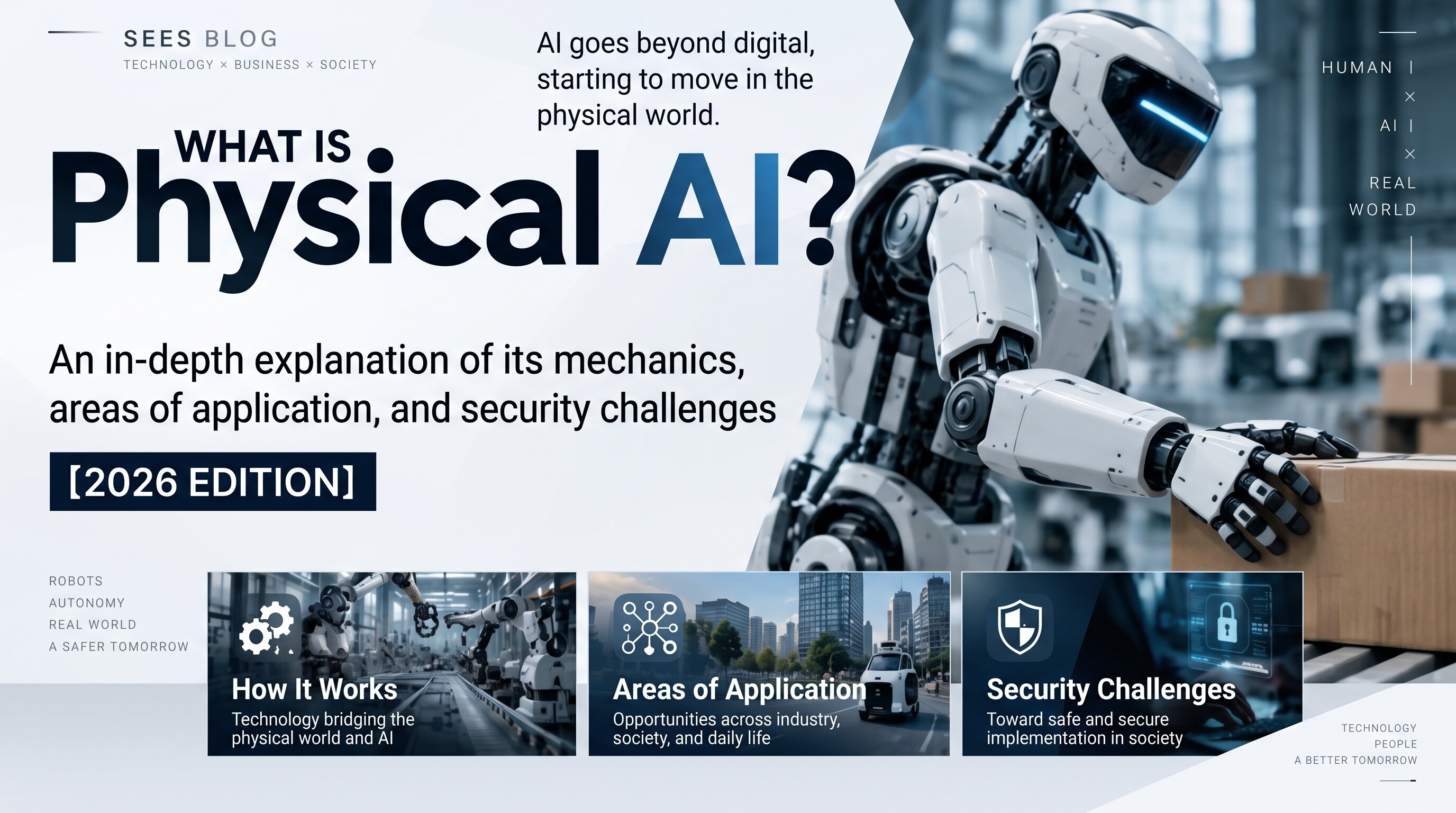
Following the widespread adoption of Generative AI, Physical AI is gaining significant attention. Moving beyond purely digital environments, Physical AI enables artificial intelligence to perceive, judge, and act in the physical world through robots, drones, autonomous vehicles, and industrial machinery.
With Physical AI, robots evolve from machines that simply repeat pre-programmed actions into systems that parse information gathered from cameras and various sensors, allowing them to make decisions and act according to their surrounding environment.
However, the proliferation of Physical AI also brings forth new security challenges.
"Can we truly trust the data that AI gathers from the physical world?"
Even if the AI model itself is functioning correctly, if sensor data is spoofed, tampered with during transmission, or sent from unauthorized devices, it can compromise the decisions made by the AI.
In the era of Physical AI, it is crucial to look beyond just the AI model and view devices, data, communications, AI, and physical actions as a single chain of trust.
- What Physical AI is
- The difference between Generative AI and Physical AI
- The 5 core elements that constitute Physical AI
- Key application fields for Physical AI
- Emerging security challenges in the Physical AI era
- Why encryption alone is not enough
- The concept of Trust Infrastructure
- Physical AI-related technologies under R&D at SEES
- What Is Physical AI?
- Differences Between Generative AI and Physical AI
- The 5 Core Elements of Physical AI
- Application Fields of Physical AI
- Security Challenges in the Era of Physical AI
- Why Encryption Alone Is Not Enough
- What Is Trust Infrastructure?
- Trust Infrastructure R&D at SEES
- From "Protecting AI" to "Protecting What AI Believes"
- How Physical AI Changes the Security Landscape
- Summary
- Frequently Asked Questions
What Is Physical AI?
Physical AI refers to a technological domain in which AI perceives real-world information through cameras and sensors, makes decisions based on that data, and interacts with the physical world via robots, machinery, and other systems.
In conventional Generative AI, users input text, images, or audio, and the AI generates digital content such as text or images as output.
In contrast, Physical AI makes decisions based on real-time data collected from the physical world, directly translating those decisions into mechanical control.
For example, an autonomous robot collects environmental data via cameras, LiDAR, and distance sensors, allowing the AI to identify people, obstacles, and navigable paths.
Based on these decisions, the AI controls motors and actuators to physically navigate through its environment.
Differences Between Generative AI and Physical AI
The differences between Generative AI and Physical AI can be summarized as follows:
| Item | Generative AI | Physical AI |
|---|---|---|
| Primary Inputs | Text, images, audio, etc. | Cameras, sensors, location data, device metrics, etc. |
| Primary Processing | Analyzing & generating information | Real-world perception, decision-making, and control |
| Primary Outputs | Text, images, audio, etc. | Decision results and control commands for robots & machinery |
| Use Cases | Chatbots, text generation, image generation, etc. | Robots, drones, autonomous vehicles, industrial machinery, etc. |
| Security Impact | Data leaks, misinformation, etc. | Data risks plus direct impacts on physical operations |
A particularly critical aspect is that AI outputs directly trigger physical movement in the real world.
Controls robotic arms and mobile mechanisms based on AI decision-making.
Perceives surrounding traffic and obstacles to inform driving and stopping decisions.
Manages flight paths and maneuvers using positional and ambient data.
Translates AI perception and analysis into actionable control of factory equipment and machinery.
It is not enough to ask "Is the AI model secure?" We must also ask "To what extent can we verify the real-world data that the AI relies on for its decisions?"
The 5 Core Elements of Physical AI
Physical AI can be broken down into the following five essential components:
1. Sensors
Sensors serve as the "eyes" and "ears" enabling Physical AI to perceive the real world.
- Cameras
- LiDAR
- Temperature sensors
- Pressure sensors
- Accelerometers
- Positioning devices (GNSS / GPS)
- Microphones
Physical AI retrieves real-world environmental data through these devices.
2. Communication
Communication channels are required to transmit collected data to AI systems or other connected devices.
In Physical AI, data exchange takes place across diverse environments--not only in the cloud, but also via edge computing and device-to-device communication.
3. AI
The AI processes and analyzes collected data to determine "what is happening" and "what processing or action is required next."
4. Control
The AI's decisions are translated into control commands sent to motors, actuators, and mechanical systems.
5. Physical Action
Finally, robots or industrial machinery execute physical movements in the real world.
If trust is compromised at any point in this flow, it can negatively impact AI decisions and final physical outcomes.
Where Is Physical AI Applied?
Physical AI is expected to be deployed across a wide range of industries where real-world perception, decision-making, and automated control are essential.
Operates alongside humans using cameras and sensors to perceive surroundings. Applications span manufacturing, logistics, retail, offices, healthcare, and eldercare.
Combines AI with robotics to enable dynamic responses to production conditions, anomaly detection, and automated assembly.
Collects real-time data from cameras and LiDAR to detect surrounding vehicles, pedestrians, and road conditions for real-time navigation.
Executes flight missions utilizing location data, video feeds, and telemetry. In autonomous multi-drone operations, device-to-device communication trust is paramount.
Powers automated guided vehicles (AGVs), autonomous mobile robots (AMRs), and smart sorting systems within modern fulfillment centers.
New Security Challenges in the Era of Physical AI
The adoption of Physical AI creates security considerations distinct from traditional IT infrastructure.
We must ask: "To what degree can we trust the data received by the AI?"
For example, suppose an autonomous delivery robot receives sensor input indicating that "no obstacles exist ahead."
If that sensor data has been spoofed or tampered with by an attacker, the AI model--even if completely uncompromised--will make decisions based on inputs that do not reflect reality.
This is a challenge that cannot be solved merely by securing the AI model itself.
Why "Data Encryption" Alone Is Not Enough
While encryption is critical for communications security, it cannot solve every security challenge in Physical AI on its own.
Even if transmission paths are encrypted, if the origin device is compromised or data is altered before encryption, the integrity of the information supplied to the AI is undermined.
Protects data content from being viewed or accessed by unauthorized entities.
Verifies that data has not been modified, altered, or tampered with unexpectedly.
Validates that devices and data sources correspond strictly to expected, authorized entities.
What Is "Trust Infrastructure" for Physical AI?
At SEES Inc., we define the trust foundation required in the Physical AI era as Trust Infrastructure.
Rather than attempting to protect Physical AI using isolated security technologies, this approach establishes a holistic chain of trust spanning from physical devices to final physical movements.
- Which specific device generated the data?
- Has the data been tampered with in transit?
- Is there any missing data or reordering of packets?
- Is stored data properly protected at rest?
- What input data did the AI rely on to reach its decision?
- Were control commands from the AI transmitted accurately and without alteration?
In Physical AI, it is essential to move beyond reviewing final AI outputs and instead make the entire data chain verifiable end-to-end.
Trust Infrastructure R&D at SEES
SEES Inc. is actively researching and developing several core technologies to build robust Trust Infrastructure for the Physical AI era.
Links continuous data streams using cryptographic hash structures to verify data integrity and continuity. Aimed at detecting real-time data tampering in Physical AI applications.
Leverages unique physical variations created during semiconductor manufacturing for hardware-bound identification and authentication. Serves as the anchor for Device Trust.
A technology for safeguarding stored data at rest. Protects sensitive information not only in transit, but also on local devices and edge computing environments.
A decentralized AI architecture where individual AI cells autonomously analyze local conditions, make decisions, and learn. Enhances availability and fault tolerance in complex Physical AI ecosystems.
Shift in Paradigm: From "Protecting AI" to "Protecting What AI Believes"
In traditional AI security, protecting AI models from attacks or preventing adversarial training data corruption are major concerns.
With Physical AI, however, security must expand to encompass real-world data feeds, as well as the devices and communication channels that capture and transmit that data.
AI does not observe the physical world directly; it processes digitized data gathered through cameras and sensors.
We must progress from merely "protecting the AI model itself" to "securing and verifying the devices and data that AI relies upon for its decisions."
How Physical AI Will Transform Security
As humanoid robotics, drones, autonomous vehicles, and smart factories become ubiquitous, the volume of real-world data processed by AI will surge exponentially.
Concurrently, the need to verify data and devices across the following parameters will become critical:
- Can data be conclusively linked to a specific physical device?
- Can devices be reliably identified and authenticated?
- Can we guarantee data has not been altered during transmission?
- To what extent can input data fed into AI models be verified?
- Are control commands sent from AI to machinery fully protected?
In the Physical AI ecosystem, enhancing AI performance and strengthening security can no longer be treated as separate goals.
Summary | In Physical AI, "What the AI Believes" Is What Matters Most
Physical AI is a technological frontier where artificial intelligence perceives the real world, makes decisions, and impacts physical surroundings through robotics and machinery.
A key distinction from Generative AI is that Physical AI outputs translate directly into mechanical control and physical movement.
- Can devices be properly identified and authenticated?
- Can the origin of sensor data be conclusively verified?
- Is data protected against tampering during transmission?
- Is stored data secured appropriately at rest?
- What exact input data is the AI utilizing for its decisions?
- Are control commands from the AI transmitted securely to machinery?
SEES Inc. views this essential foundation of trust as Trust Infrastructure and is advancing R&D on technologies including Hash Chains, Chip Fingerprints, Scramble Memory, and Autonomous Distributed AI Cells.
lies the question: "What does the AI rely on to make decisions?" In Physical AI, the trustworthiness of data bridging AI and the physical world is paramount.
Frequently Asked Questions About Physical AI
What is Physical AI?
Physical AI refers to an AI domain where systems collect and perceive real-world information via cameras and sensors, analyze that data to make decisions, and act upon the physical world through robotics, drones, or machinery.
What is the difference between Physical AI and Generative AI?
Generative AI primarily produces digital outputs such as text, images, or audio. In contrast, Physical AI outputs directly control physical machinery and robots, directly impacting the physical world.
What kind of security does Physical AI require?
Beyond protecting AI models, Physical AI requires a comprehensive system-wide security framework that covers device identification and authentication, verification of data origin and integrity, transmission security, data-at-rest protection, and control command validation.
Why is data authenticity so critical in Physical AI?
Because AI bases its decisions entirely on incoming data. If sensor feeds are spoofed or tampered with, even a perfectly functioning AI model will produce incorrect or hazardous decisions based on false inputs.
Is encryption alone insufficient for Physical AI security?
While encryption ensures communication confidentiality, it cannot resolve all security issues on its own. Physical AI also requires origin verification, device authentication, and end-to-end data integrity validation.
What is Trust Infrastructure?
Trust Infrastructure is a foundational security concept developed by SEES Inc. that provides holistic end-to-end trust across devices, data, communications, AI models, and physical actuators in Physical AI systems.
Which fields will adopt Physical AI?
Physical AI is anticipated across numerous sectors, including humanoid robotics, industrial automation, drones, autonomous vehicles, smart logistics, and smart factories where real-world perception and control are required.