



























With the rapid adoption of Physical AI across robotics, drones, autonomous vehicles, and smart factories, vast networks of remote devices are actively interconnecting with AI decision engines.
In these operational environments, authenticating a device once during initial setup is no longer sufficient.
For remotely deployed endpoints, organizations must continually answer a critical operational question: "Is this remote device currently executing in a known, trusted state?"
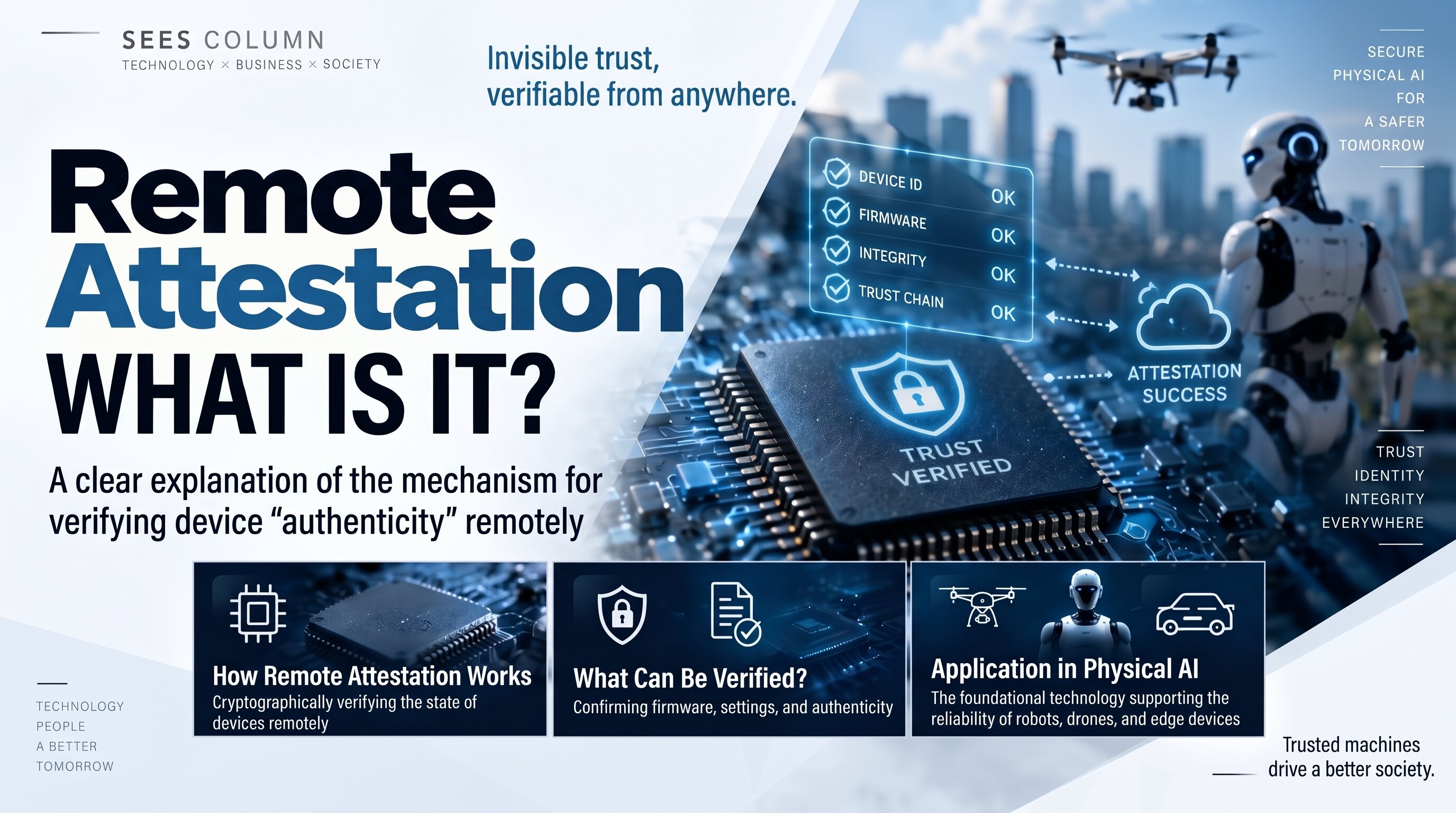
The core technology addressing this challenge is Remote Attestation.
Remote Attestation is a security mechanism in which a remote device or system presents verifiable Evidence regarding its operational state, enabling an external verifier to evaluate its integrity and trustworthiness from a remote location.
In Physical AI, Remote Attestation functions as vital Trust Infrastructure for autonomous robots, drones, and edge AI compute nodes--remotely verifying hardware and software configurations to determine whether to authorize network connectivity, data ingestion, or AI inference loops.
- What Remote Attestation is
- How Remote Attestation operates at a fundamental level
- Understanding the roles of Attester, Verifier, and Relying Party
- The distinction between Evidence and Attestation Results
- How Remote Attestation differs from standard device authentication
- Connecting Remote Attestation to Hardware Root of Trust
- How Remote Attestation relates to TPMs and PUFs
- Linking Remote Attestation with Machine Identity
- Why Remote Attestation is essential for Physical AI systems
- Extending trust seamlessly from Device Trust to Data Trust
- What Is Remote Attestation?
- Why Remote Device Verification Is Essential
- Basic Architecture of Remote Attestation
- Understanding Attester, Verifier, and Relying Party Roles
- Evidence vs. Attestation Results
- Device Authentication vs. Remote Attestation
- The Role of Hardware Root of Trust
- Integration with TPMs and PUFs
- Connecting with Machine Identity
- Why Remote Attestation Is Critical for Physical AI
- Bridging Remote Attestation to Data Trust
- Key Domains Requiring Remote Attestation
- Building Physical AI Trust Infrastructure
- Summary
- Frequently Asked Questions
What Is Remote Attestation?
Remote Attestation is a security architecture that allows an external system to evaluate the trustworthiness of a remote device based on verifiable Evidence reflecting its real-time operational state.
For example, imagine a remotely deployed industrial robot requesting connection to an enterprise Physical AI control network.
Even if that robot successfully authenticates its hardware identity credentials, verifying its current software and operational health remains an independent requirement.
- Is the physical hardware authentic and uncompromised?
- Is the executing firmware verified and untampered?
- Is the OS and software stack in a known-good configuration?
- Can the platform measurement during boot be verified?
- Does the runtime environment comply with enterprise security policies?
Remote Attestation gathers and evaluates cryptographically signed Evidence to provide reliable proof for authorizing remote device access.
When asking "On what basis should we trust this remote endpoint?", Remote Attestation provides an objective answer using cryptographically verifiable Evidence.
Why Remote Device Verification Is Essential
In traditional enterprise IT, security teams could enforce physical control over servers and desktop workstations located within managed facilities.
In Physical AI architectures, vast fleets of autonomous robots, environmental sensors, commercial drones, and edge nodes operate outside physical perimeters in remote environments.
Systems cannot assume that a device is secure simply because it establishes a network connection.
Instead, modern security architectures demand that endpoints present verifiable Evidence of their operational integrity before trust and operational control are granted.
Basic Architecture of Remote Attestation
While technical implementations vary, Remote Attestation relies on a structured flow where the target device measures its software/hardware environment and generates cryptographic Evidence for evaluation.
Crucially, Remote Attestation is not simply "trusting self-reported device claims."
The architecture verifies the cryptographic authenticity and payload integrity of Evidence against signed Reference Values and security policies before making an authorization decision.
Understanding Attester, Verifier, and Relying Party Roles
To understand Remote Attestation architectures (such as the IETF RATS model), it helps to define the three primary entities:
The target endpoint (e.g., robot, drone, edge gateway) that gathers measurements and outputs signed Evidence regarding its internal state.
The authoritative entity that evaluates Evidence against golden Reference Values and appraisal policies to produce Attestation Results.
The service engine (e.g., AI inference server, cloud gateway) that consumes Attestation Results to make final access or trust decisions.
The Attester presents evidence, the Verifier evaluates that evidence against baseline policies, and the Relying Party consumes the verdict to authorize operations.
Evidence vs. Attestation Results
In attestation architectures, establishing a clear distinction between Evidence and Attestation Results is critical.
| Parameter | Evidence | Attestation Results |
|---|---|---|
| Definition | Raw, cryptographically signed measurement proof output by the Attester | The evaluated appraisal report produced by the Verifier |
| Generated By | Attester (Device) | Verifier (Attestation Server) |
| Function | Provides raw state telemetry for appraisal | Provides verified appraisal claims for authorization decisions |
| Consumed By | Verifier | Relying Party (Service / AI Engine) |
Raw Evidence alone does not equate to a final verdict of "this device is safe."
The Verifier must appraise the Evidence against security baselines, generating signed Attestation Results that the Relying Party uses to grant or deny operational permissions.
Device Authentication vs. Remote Attestation
While device authentication and Remote Attestation are closely related, they evaluate different security dimensions.
| Parameter | Device Authentication | Remote Attestation |
|---|---|---|
| Primary Question | "Who is this device?" | "What operational state is this device currently in?" |
| Evaluation Focus | Cryptographic Identity credentials & tokens | Platform measurements, firmware/software state, execution policy |
| Objective | Identify and authenticate endpoint identity | Evaluate real-time operational state and platform health |
| Physical AI Role | Machine Identity & Device Trust root | Remote runtime verification & state health attestation |
The Role of Hardware Root of Trust
A fundamental challenge in Remote Attestation is answering: "Why should the Verifier trust the measurement Evidence generated by the remote device?"
If standard OS-level software measures its own state, a compromised operating system could easily forge false measurement reports to mask malware or tampering.
Therefore, generating trustworthy Evidence requires an immutable Hardware Root of Trust.
While Hardware Root of Trust establishes where initial system trust is anchored, Remote Attestation provides the protocol for evaluating state health remotely based on that anchor.
Integration with TPMs and PUFs
Remote Attestation is an architectural model rather than a single proprietary hardware chip.
Implementations leverage underlying hardware security primitives, such as TPMs or PUFs, to measure platform states and cryptographically sign Evidence.
Trusted Platform Module. Protects PCR (Platform Configuration Register) measurements and executes cryptographic signing for attestation quotes.
Physical Unclonable Function. Leverages physical silicon variations to anchor device identity and derive hardware-bound signing keys.
Provides the uncompromised hardware foundation required to collect measurements and sign attestation Evidence.
Adding a PUF chip alone does not instantly complete a Remote Attestation architecture.
Building a functional system requires uniting hardware roots, measurement engines, Evidence generation, Verifiers, and appraisal policies into an integrated pipeline.
Connecting Machine Identity with Remote Attestation
Machine Identity provides unique, cryptographic identity credentials for non-human endpoints like industrial robots, sensors, and IoT gateways.
Machine Identity answers "Which specific endpoint is this?", while Remote Attestation verifies "In what operational state is this endpoint executing?"
Why Remote Attestation Is Critical for Physical AI
In Physical AI environments, AI inference engines process real-time telemetry streams generated by edge hardware deployed across physical spaces.
An autonomous drone, for instance, runs multiple onboard computing systems, flight controllers, optical cameras, and GPS receivers.
If an AI model relies on telemetry from that drone to issue real-world flight commands, evaluating the health and integrity of the source hardware/software environment becomes essential for physical safety.
- When an edge device requests network session authorization
- When granting endpoints permission to access AI models or cloud APIs
- Before ingesting sensitive telemetry into critical AI decision loops
- Validating platform health following over-the-air (OTA) firmware updates
- Continuously monitoring security compliance across large-scale remote fleets
Bridging Remote Attestation to Data Trust
While verifying endpoint state via Remote Attestation is vital, it does not guarantee complete Physical AI security on its own.
Systems must also answer: "Can the streaming data payloads generated and transmitted by this device be verified as authentic and untampered?"
SEES Inc. utilizes Chip Fingerprints to confirm Hardware Authenticity at the physical silicon root, while pairing software Hash Chains to verify Data/Software Authenticity, Payload Integrity, and Sequence Continuity.
Verified via Chip Fingerprints to confirm physical hardware authenticity.
Evaluated via Remote Attestation Evidence to verify remote platform health.
Verified via SEES Hash Chains + Seeds to confirm data source authenticity.
Validated via Hash Chains to ensure streaming payload integrity and timing sequence.
Key Domains Requiring Remote Attestation
Remote Attestation is essential across domains where large fleets of autonomous endpoints operate in remote environments and require continuous state verification.
Verifying hardware and software state on remote robots before authorizing network and control access.
Appraising flight controller and system health to establish trust with cloud flight management systems.
Remotely attesting in-vehicle compute platforms and ECU software configurations.
Validating platform integrity across industrial robots, edge gateways, and PLCs.
Verifying health and software configurations across large-scale deployed edge nodes.
Attesting that workload execution environments comply with strict isolation and platform policies.
From Remote Attestation to Physical AI Trust Infrastructure
In Physical AI, relying solely on device IDs, Remote Attestation, or encryption in isolation is insufficient.
Security architectures must establish unbroken trust spanning semiconductors, devices, data feeds, networks, AI inference models, and real-world physical actuation.
SEES Inc. defines this comprehensive, end-to-end framework as Physical AI Trust Infrastructure.
Starting from a Hardware Root of Trust, systems combine Machine Identity for authentication with Remote Attestation for state appraisal, connecting trust seamlessly from trusted Devices to Data, AI, and Physical Action.
Summary | Remote Attestation Evaluates "Can We Trust This Remote Endpoint?"
Remote Attestation is an architectural framework where a device presents verifiable Evidence regarding its operational state to an external engine, enabling remote evaluation of its platform integrity and trustworthiness.
In standard flows, an Attester outputs Evidence, a Verifier evaluates that Evidence against golden policies to generate Attestation Results, and a Relying Party consumes those results to enforce access decisions.
- Gathering cryptographic Evidence of remote device state
- Appraising Evidence against baselines using an authoritative Verifier
- Enforcing authorization decisions using Attestation Results
- Anchoring measurement generation in a Hardware Root of Trust
- Combining with Machine Identity to verify both "identity" and "state"
- Bridging Device Trust seamlessly into Data Trust
In Physical AI, AI inference models consume telemetry generated by remote robots and edge endpoints to drive real-world physical actuation.
Frequently Asked Questions About Remote Attestation
What is Remote Attestation?
It is a framework in which a device presents verifiable Evidence regarding its hardware/software state to an external engine, allowing remote appraisal of its operational integrity and trustworthiness.
How does Remote Attestation differ from device authentication?
Device authentication verifies "who is this device?" using identity credentials. Remote Attestation evaluates "what operational state is this device in?" by appraising Evidence of hardware and software configurations.
What is an Attester?
In Remote Attestation architectures, the Attester is the target endpoint (e.g., robot, drone, edge gateway) that gathers measurements and generates signed Evidence regarding its internal state.
What is a Verifier?
The Verifier is the authoritative service that appraises Evidence submitted by an Attester against golden Reference Values and security policies to produce Attestation Results.
What is Evidence?
Evidence consists of measurement data and cryptographic claims generated by an Attester regarding its hardware and software state, submitted to a Verifier for appraisal.
How does Hardware Root of Trust relate to Remote Attestation?
Hardware Root of Trust provides an uncompromised silicon foundation for collecting platform measurements and signing Evidence, ensuring that submitted attestation proof cannot be forged by compromised software.
Is a TPM required for Remote Attestation?
No. While many systems utilize TPMs for PCR measurements and attestation quotes, Remote Attestation is an architectural pattern that can be implemented using various hardware security primitives depending on platform requirements.
How do PUFs relate to Remote Attestation?
PUFs leverage silicon manufacturing variations to anchor hardware identity and derive signing keys. While a PUF alone does not constitute a full attestation framework, it serves as a powerful hardware building block for attestation engines.
Why is Remote Attestation vital for Physical AI?
Because AI decision engines consume telemetry generated by remote robots and edge devices to trigger physical real-world actions. Verifying the health and operational state of remote hardware before processing its telemetry is essential for system safety.